
Introduction
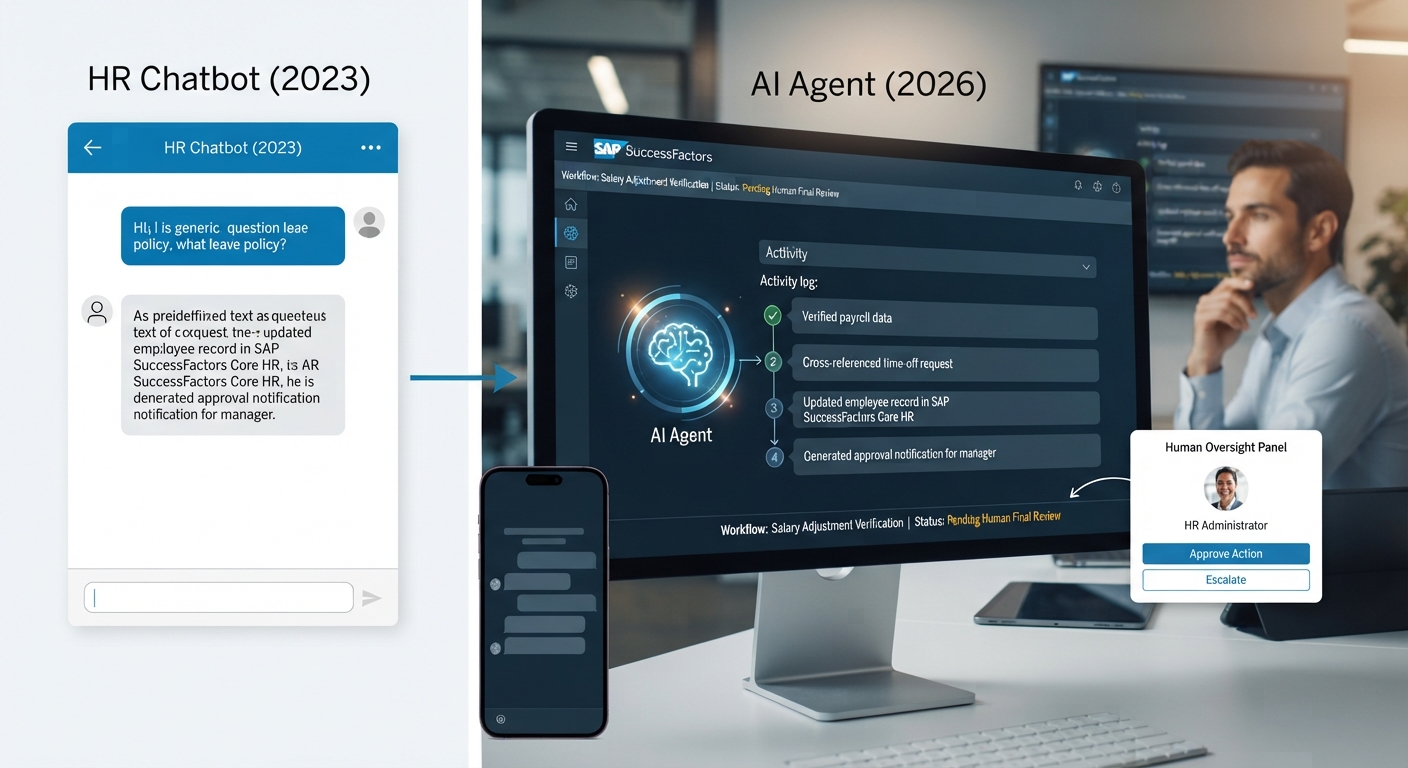
AI agents in HR have moved past the marketing slide. In 2026, HR technology vendors, including SAP, are shipping software that does more than answer questions: it can review data, decide on a next step, and act inside an HR process, sometimes without a person approving every move. For SAP SuccessFactors teams, that shift raises a practical question: which of these tools are actually available today, which are still on the roadmap, and what has to be true about your data, permissions, and oversight before an agent touches an employee’s payroll question or performance review.
This article separates AI agents in HR from the chatbots, assistants, and automation tools they are often confused with. It looks at where SAP SuccessFactors has introduced agent capabilities through its Joule platform, what SAP has confirmed versus what remains planned, and the risks HR and IT leaders need to manage before scaling adoption. Where the evidence is incomplete or conflicting, this article says so directly rather than filling the gap with a guess.
What Are AI Agents in HR?
An AI agent in HR is a software system that can take in information from HR systems and data sources, reason about a goal, choose among possible actions, and carry out multi-step tasks with a defined degree of autonomy, rather than simply responding to a single prompt.
That last part is the key distinction. A generative AI tool creates content on demand, such as drafting a job description. An AI agent goes further: it can plan a sequence of steps, use multiple tools or data sources, evaluate the result, and adjust its approach, according to Amazon’s own description of how it builds AI agents (About Amazon, May 2026). In an HR context, that might mean an agent that reviews a payroll discrepancy, checks the underlying time and attendance data, and drafts an explanation for the employee, rather than a chatbot that can only point to a policy document.
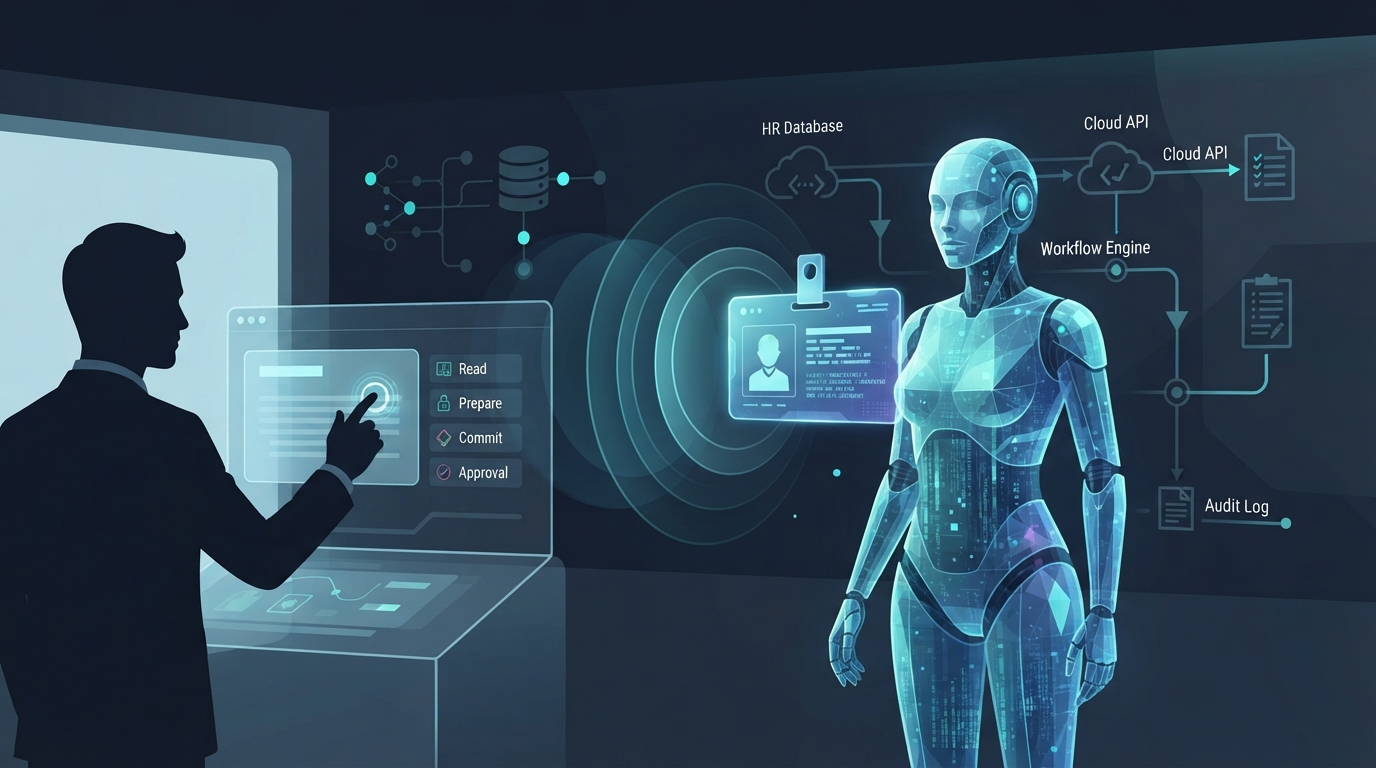
Autonomy in enterprise HR is a spectrum, not a switch. Most production deployments today sit closer to “agent proposes, human approves” than “agent acts entirely unsupervised,” particularly for anything touching pay, personal data, or employment status.
AI Assistants vs Automation vs AI Agents
The terms get used loosely, but the underlying technology behaves differently:
Chatbots follow scripted or rule-based logic. They answer a narrow set of questions and cannot handle anything outside their programmed scope.
AI assistants use large language models to hold a conversation, retrieve information, and draft content. They are more flexible than chatbots, but a person still has to read the output and take the next action.
Workflow automation executes a predefined, multi-step process reliably and consistently. It does not reason about unfamiliar situations; it follows the rules it was built with.
AI agents combine reasoning with action. They can interpret a goal, select among available tools or data sources, carry out several steps in sequence, and adapt when conditions change, within whatever guardrails and approval points a company builds around them.
Comparison: Chatbots, Assistants, Automation, and Agents
| Technology type | Typical behavior | Level of autonomy | Human involvement | Example HR use | Main risk |
|---|---|---|---|---|---|
| Chatbot | Scripted responses to known questions | None | Human handles anything outside the script | Answering “What is our PTO policy?” | Cannot handle nuance or edge cases |
| AI assistant | Conversational, drafts and retrieves content | Low | Human reviews and acts on output | Drafting an internal job posting | Plausible-sounding but incorrect content |
| Workflow automation | Executes fixed, predefined steps | Low to moderate, but not adaptive | Human designs the process upfront | Routing a new-hire form to payroll | Breaks when the situation falls outside the rules |
| AI agent | Reasons, plans, and acts across multiple steps | Variable, from supervised to largely autonomous | Depends on guardrails set by the deployer | Reviewing a payroll variance and drafting an explanation | Acting on incomplete or incorrect data with limited oversight |
Where AI Agents Can Help HR
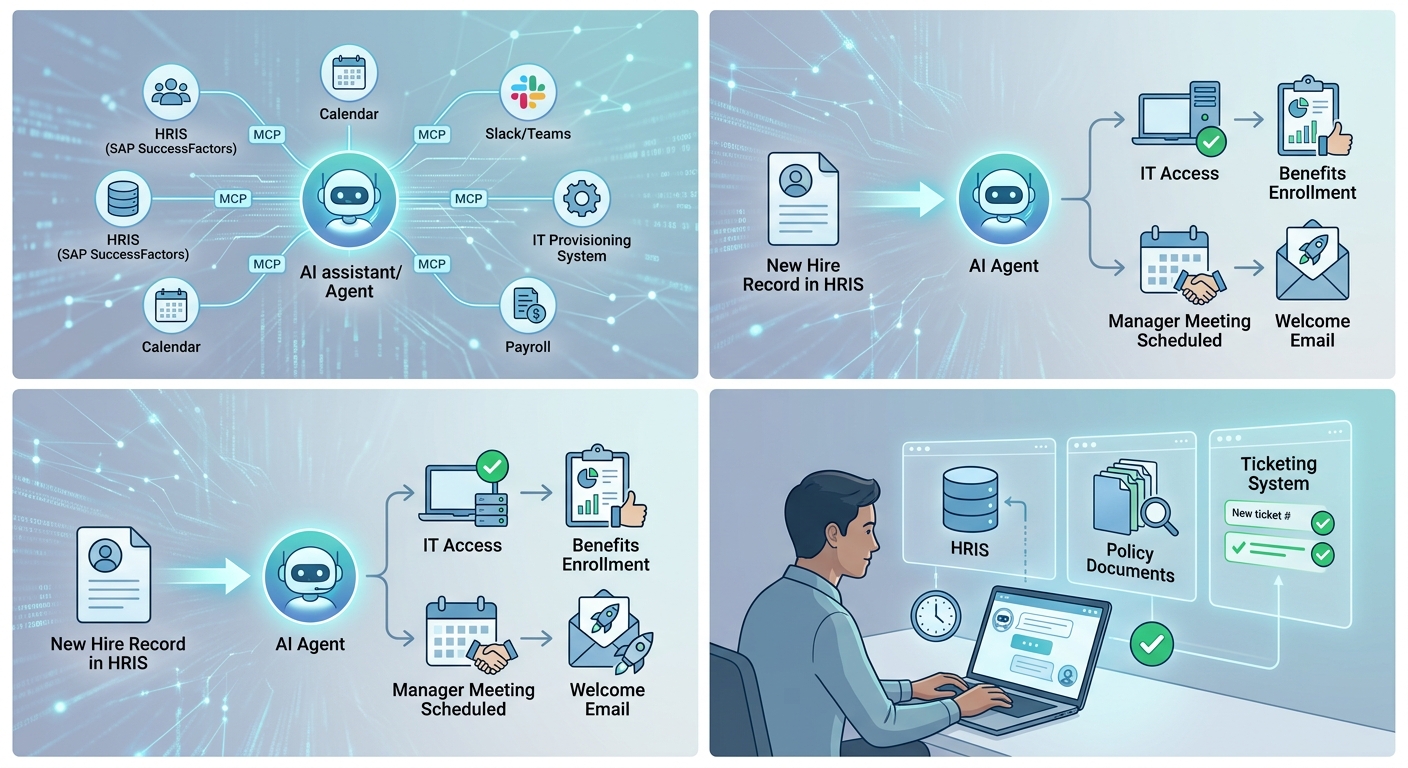
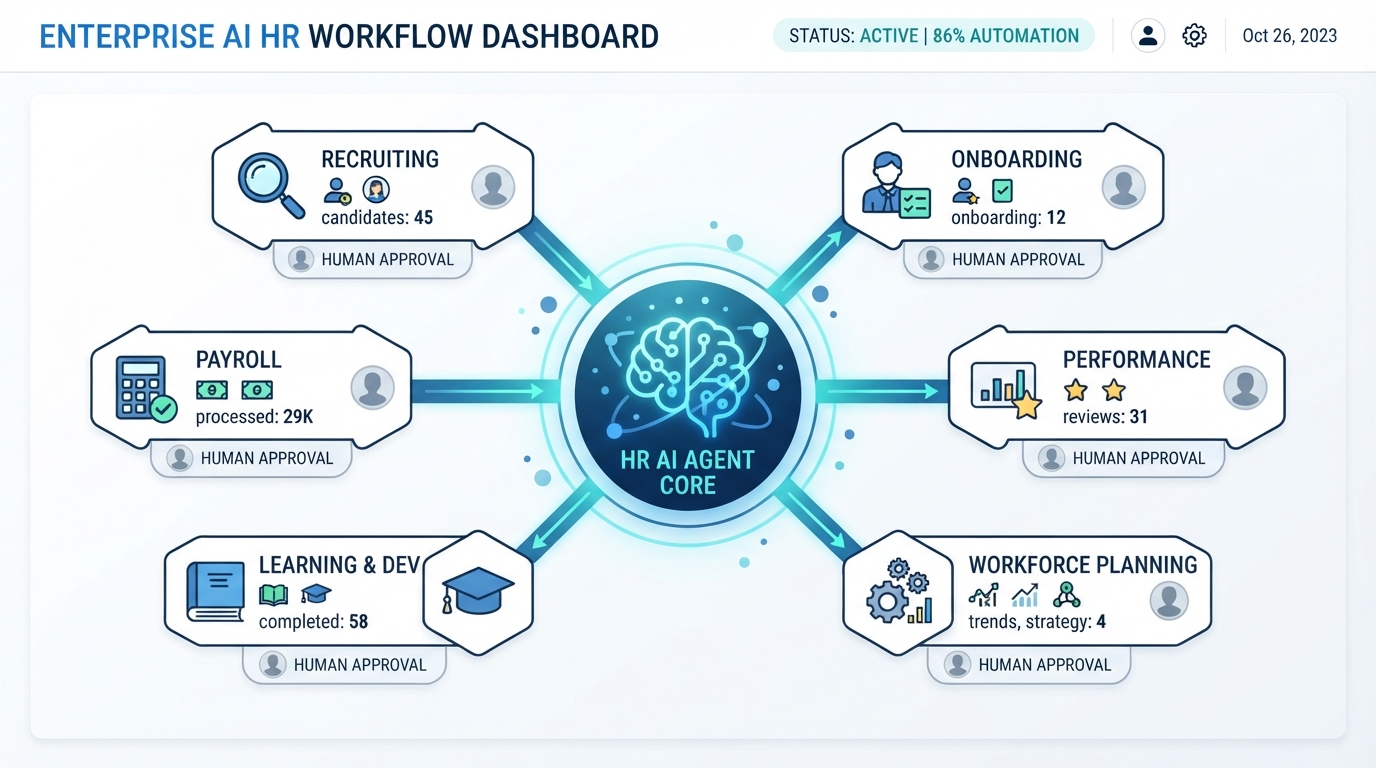
SAP has described several agent capabilities for SuccessFactors through its Joule platform, alongside broader, vendor-neutral use cases seen across the HR technology market.
Employee HR service. SAP describes an HR Service Agent intended to serve as a direct point of contact for employees and reduce the volume of routine HR questions reaching a human team (SAP News, October 2025). This is a common pattern across HR service-delivery platforms generally, not unique to SAP.
Payroll explanation and support. SAP’s Payroll Agent is described as helping employees understand their compensation by combining paycheck details with time data and explaining variances such as overtime (SAP News, October 2025). The explanatory role matters: an agent that explains an existing payroll calculation is a different risk profile than one that could alter payroll data.
Learning and development. Across the HR technology market more broadly, agent-style tools are being positioned to recommend personalized learning content or coordinate microlearning based on a role or skill gap. This is a general industry pattern rather than a claim specific to one vendor.
Career and talent development. SAP’s Career and Talent Development Agent is described as supporting succession planning and helping identify and develop future leaders (SAP News, October 2025).
Recruiting workflow support. General industry use cases include summarizing candidate materials, coordinating interview scheduling, and drafting outreach, with a human retaining hiring authority. Because hiring is a high-risk category under emerging AI regulation (discussed below), any agent involved in candidate evaluation warrants close scrutiny of how it weighs information.
People analytics and workforce insights. SAP’s People Intelligence Agent is described as connecting its People Intelligence application with Joule, enabling natural-language queries against workforce data (SAP News, October 2025).
HR case triage. A widely discussed pattern industry-wide is using an agent to classify and route HR service cases by topic or urgency, reducing time to the right specialist. This is a general capability pattern rather than a confirmed statistic from any single source verified for this article.
Manager self-service. SAP’s Performance and Goals Agent is described as helping managers prepare for performance conversations with tailored insights, goal-progress updates, and talking points (SAP News, October 2025), with SAP stating an intended general availability in November 2025.
[Internal link: HR technology and systems overview]
What SAP SuccessFactors Teams Should Validate
Before treating any SAP SuccessFactors AI agent as production-ready, teams should confirm the following directly with SAP or through hands-on testing, rather than relying on marketing timelines:
- Product scope and entitlement. Confirm which agents are actually included in your license or module tier.
- Release status. This is where the evidence gets genuinely inconsistent (see below), so get a written, dated confirmation from your SAP account team rather than assuming an agent is live because it was announced.
- Role-based permissions. Verify exactly what each agent can see and do for each employee role, including manager and HR administrator roles.
- Data sources and data quality. An agent is only as reliable as the Employee Central and related data feeding it. Data-quality issues that were previously just reporting problems become action-taking problems once an agent can act on that data.
- Integration dependencies. Identify which SuccessFactors modules and external systems an agent depends on, and what happens if one of those is unavailable or delayed.
- Human approval points. Define explicitly which agent outputs require sign-off before they reach an employee or take effect, particularly anything touching pay or employment status.
- Audit logs and monitoring. Confirm you can reconstruct what an agent did, what data it used, and why, after the fact.
- Error handling and escalation. Establish what happens when the agent’s confidence is low or source data conflicts, and where the case lands.
- Security and privacy. Review data residency, access scoping, and SAP’s own security documentation for the agent architecture.
- Change management and adoption. Plan for clear disclosure to employees that they are interacting with an AI system, and a path to reach a human.
[Internal link: SAP SuccessFactors integration guide]
On release status specifically: SAP announced five Joule HR agents at SAP Connect in October 2025. SAP stated the Performance and Goals Agent would reach general availability in November 2025, with the Career and Talent Development, HR Service, Payroll, and People Intelligence agents targeted for the first half of 2026 (SAP News, October 2025). However, a third-party review of SAP’s own 1H 2026 SuccessFactors release announcement, conducted in July 2026, found that the announcement named all four of those agent areas but attached no general-availability, beta, or early-adopter label to any of them, and recommended that buyers not include them in committed business cases until SAP confirms status in writing (Altivate, reviewed July 2026). Separately, at SAP’s Sapphire event in 2026, SAP described a broader set of “Autonomous HCM” capabilities, including coordinated HR agents for payroll, hiring, and workforce planning, targeted for general availability in November 2026 (Reworked, 2026). Available reporting does not clearly state whether this November 2026 initiative supersedes, incorporates, or runs alongside the four agents announced in October 2025. Treat this as an open question to raise directly with SAP, not a settled fact.
The Main Risks of AI Agents in HR
Sensitive personal-data exposure. Agents that can query across HR systems increase the number of pathways through which personal data could be exposed if permissions are misconfigured.
Inaccurate or hallucinated responses. Language-model-based systems can generate plausible but incorrect answers. In HR, an incorrect payroll or benefits explanation is not a cosmetic error.
Bias and discrimination. AI systems used in employment decisions can reproduce or amplify bias present in historical data, particularly in recruiting and performance contexts. This is not a hypothetical concern: the U.S. Equal Employment Opportunity Commission had published technical assistance documents in May 2022 and May 2023 addressing AI’s potential for ADA and Title VII violations in employment tools. Those documents, along with a December 2024 fact sheet on workplace wearables, were removed from eeoc.gov in January 2025, following a change in federal AI policy direction (Cooley, February 2025), and independent verification found the pages still unavailable as of March 2026 (National Law Review, 2026). Importantly, removing federal guidance does not repeal the underlying anti-discrimination laws: Title VII and ADA protections continue to apply to AI-influenced employment decisions regardless of whether technical guidance is published (Cooley, February 2025). Several U.S. states have been developing their own AI employment rules in this period, which this article did not exhaustively research.
Excessive autonomy. An agent operating beyond its intended scope, whether through misconfiguration or an unclear boundary, can take actions no one authorized.
Incorrect payroll or case guidance. Related to hallucination but specific to HR: an agent confidently explaining an incorrect pay calculation can cause real financial and trust harm.
Inadequate access controls. Role-based permissions that were adequate for a reporting dashboard may not be adequate once an agent can act on that same data.
Lack of explainability. If an agent cannot show its reasoning or data sources, HR cannot defend a decision it influenced, to an employee, an auditor, or a regulator.
Automation bias. Humans tend to over-trust automated output and stop scrutinizing it, even when the system is wrong. This is a documented risk pattern in human-in-the-loop system design, not unique to HR.
Vendor or model dependency. Relying on a single vendor’s agent architecture creates switching costs and exposes an organization to unannounced changes in model behavior.
Regulatory and legal uncertainty. Under the EU AI Act, AI systems used in recruitment or in decisions affecting the terms of employment fall under the regulation’s high-risk category (Annex III), which carries obligations including risk management, human oversight, and documentation. The original compliance deadline for these high-risk obligations was August 2, 2026 (Gibson Dunn, 2026). The European Parliament and Council subsequently agreed to delay most of these obligations to December 2, 2027, through the AI Act’s “Digital Omnibus” package, with Parliament adopting the text on June 16, 2026, and the Council giving final approval on June 29, 2026 (Secure Privacy, updated September 2026). As of this writing, formal publication of that change in the EU’s Official Journal, which is what makes it legally binding, had not been independently confirmed, and certain transparency obligations under Article 50 remain due regardless of the delay (Gibson Dunn, 2026). Organizations operating in the EU should confirm the current status directly rather than relying on any single article, including this one, and should treat this as a compliance consideration rather than legal advice.
[Internal link: Ethical considerations for AI and data privacy in HR]
A Practical Adoption Framework
Phase 1: Identify and classify use cases. Separate informational use cases (answering policy questions) from decisional ones (influencing pay, hiring, or performance outcomes), and flag which involve sensitive personal data.
Phase 2: Establish data and access controls before piloting. Fix data-quality and permissions issues before an agent can act on them, not after.
Phase 3: Start with low-risk, high-volume use cases. Policy navigation and general HR questions are a reasonable starting point; decisions affecting pay or employment status are not.
Phase 4: Pilot with measurable success criteria. Define accuracy, escalation rate, and employee satisfaction targets before launch. This step matters more than it sounds: SHRM’s 2026 research found that 56% of HR functions do not formally measure the success of their AI investments, and only 16% use ROI as a metric (SHRM, 2026), which makes it hard to know whether a pilot actually worked.
Phase 5: Build in human approval and monitoring. Keep a defined human checkpoint for anything touching pay, status, or personal decisions, with audit logs that let you reconstruct what happened.
Phase 6: Scale only after evidence. Expand based on pilot results and demonstrated reliability, not a vendor’s release calendar. The same SHRM research found that 52% of organizations do not involve HR in AI strategy or vision-setting at all (SHRM, 2026), which is a governance gap worth closing before scaling any HR-specific deployment.
Questions to Ask Before Deployment
- What specific decisions or actions can this agent take without human approval?
- What data does it use, and how current and accurate is that data?
- Who can see the agent’s outputs, and who can override them?
- Can we reconstruct, after the fact, exactly what the agent did and why?
- What happens when the agent is uncertain or the data conflicts?
- Have we confirmed this agent’s actual availability and support status in writing with the vendor?
- Does this use case fall under any high-risk AI classification in the jurisdictions where we operate?
- How will employees be told they are interacting with an AI system, and how can they reach a human?
- What is our fallback if the vendor changes the underlying model or discontinues the feature?
The Future of AI Agents in HR
Analysts and vendors broadly expect AI agents in HR to take on more multi-step work over time, but the pace and shape of that expansion is genuinely uncertain, and the industry’s own signals are mixed. SAP’s shifting release framing between 2025 and 2026, from four named agents targeted for the first half of 2026 to a broader “Autonomous HCM” initiative targeted for November 2026, illustrates that even vendors are still adjusting their own roadmaps in real time. Regulatory timelines are similarly in motion: the EU’s compliance deadline for high-risk employment AI has already been renegotiated once in 2026.
None of this means AI agents in HR are unready for any use. It means the responsible approach is to treat availability, capability, and compliance claims as things to verify on an ongoing basis, not settled facts to build a permanent strategy around. AI agents are unlikely to replace HR professionals; the more grounded expectation, supported by the evidence available, is that they will change which tasks HR staff spend time on.
[Internal link: Digital transformation in HR resources]
Conclusion
AI agents in HR are a real and increasingly distinct category of HR technology, different from the chatbots and dashboards that preceded them, because they can reason across steps and take action rather than simply respond. For SAP SuccessFactors teams, the practical work in 2026 is less about deciding whether to adopt agents and more about verifying, agent by agent, what is actually available, what data and permissions it touches, and where a human needs to stay in the loop. The evidence gathered for this article shows a technology category moving quickly, with vendor timelines and regulatory deadlines both still shifting. Organizations that build validation, human oversight, and clear success metrics into their adoption process from the start will be better positioned than those that adopt on the strength of a roadmap slide alone.
Sources and Further Reading
- New SAP SuccessFactors Innovations — SAP News Center, October 2025
- SAP Joule Availability & AI Roadmap — Altivate, reviewed July 2026
- SAP Launches Unified AI Platform, 50+ AI Assistants and Autonomous HR at Sapphire 2026 — Reworked, 2026
- What is agentic AI? Amazon’s approach to reliable AI agents — About Amazon, May 2026
- EU AI Act Omnibus Agreement — Postponed High-Risk Deadlines and Other Key Changes — Gibson Dunn, 2026
- EU AI Act Digital Omnibus: The New High-Risk AI Deadlines After Council Approval — Secure Privacy, updated September 2026
- Gone but Not Forgotten: Federal Laws Still Apply Despite AI Guidance Disappearance Act — Cooley, February 2025
- The Federal Government Quietly Removed Its AI Hiring Guidance — National Law Review, 2026
- The State of AI in HR in 2026: 5 Critical Insights for CHROs — SHRM, 2026
- AI Risk Management Framework — NIST
One thought on “AI Agents in HR Are Moving from Chatbots to Digital Coworkers: What SAP SuccessFactors Teams Need to Know in 2026”