
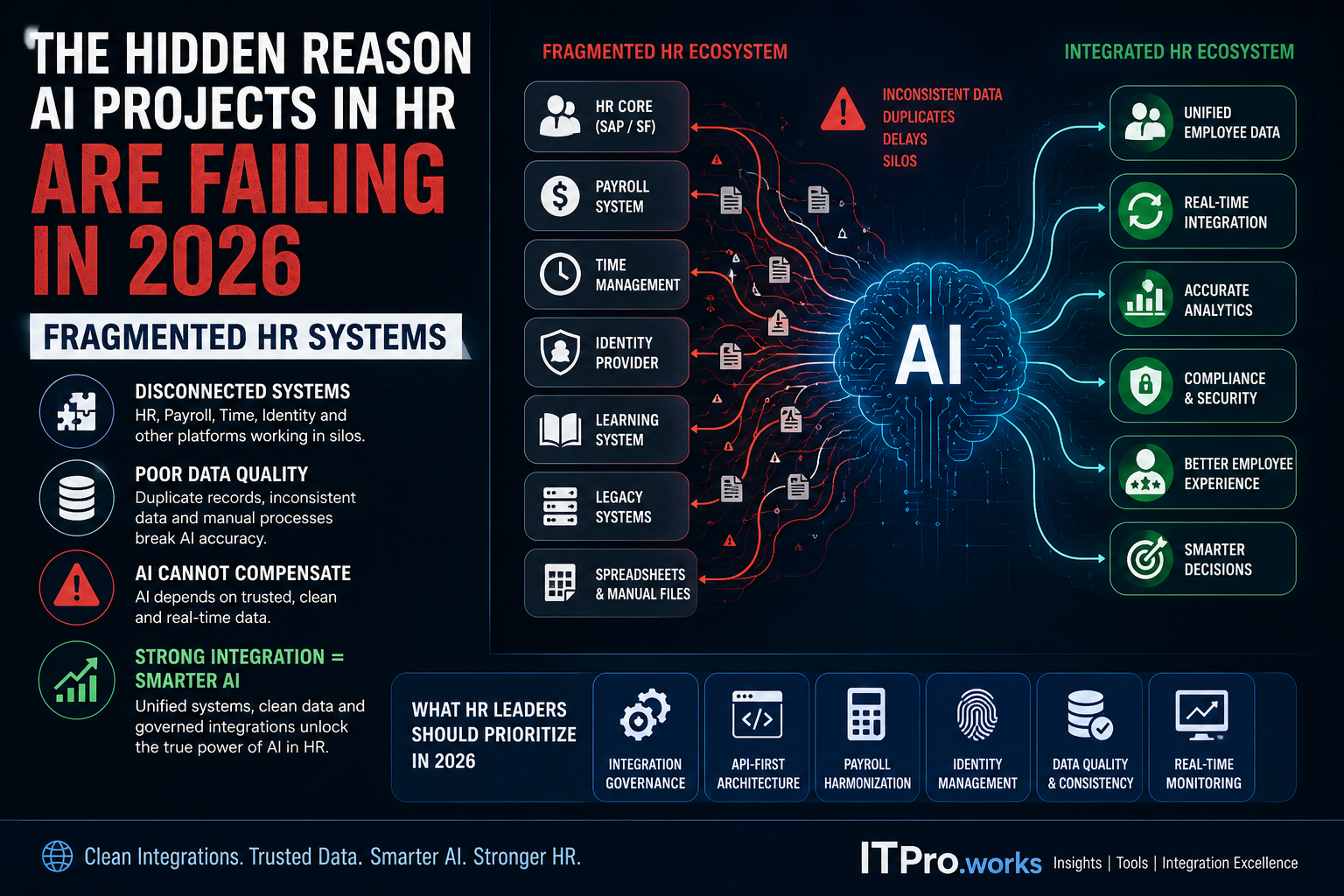
Most HR AI initiatives do not stall because the model is wrong. They stall because the employee data feeding the model cannot be defended. Someone asks “why did the agent say this person reports to that manager?”, and the answer requires three people, two systems and a database restore.
This article is for HRIS leads, integration architects and HR technology owners running SAP SuccessFactors Employee Central alongside S/4HANA, who are being asked to support AI use cases on top of a landscape that was designed for nightly batch replication. You will get a four-layer reference model, a replay test you can run against any existing interface this week, concrete extraction and identity patterns, and a 30-day plan.
Why I’m writing this. I work on SuccessFactors–S/4HANA integrations for a living: Compound Employee extractions, Business Integration Builder configuration, CPI iFlows, IDoc and OData endpoints, and the IAS/IPS layer underneath. Over the last two years, nearly every AI conversation I have joined has arrived at the same bottleneck within an hour, and it is never the model. It is effective dating, identity mapping and the absence of replayable payloads.
Context: why HR AI pilots hit the integration layer first
Two things are true at once in most SAP HR landscapes.
First, HR data is bitemporal by design. Employee Central stores time slices: a record is valid from a date, and it was also entered on a date. A promotion keyed in on 3 March effective 1 June is simultaneously a future fact and a present change. Payroll, finance and compliance all depend on that distinction.
Second, most AI consumption layers flatten it. Vector stores, feature tables and agent context windows want one row per employee. The moment you flatten, you lose the ability to answer “what was true on this date” — which is exactly the question that arises when an AI-assisted decision is challenged.
The regulatory direction reinforces this. Under the EU AI Act, AI systems used for recruitment, candidate evaluation, task allocation, performance monitoring and decisions on promotion or termination fall under Annex III, point 4, as high-risk. Obligations for Annex III systems — including data governance, record-keeping and human oversight — apply from 2 December 2027. Whatever your organisation ultimately deploys, the integration layer is where record-keeping and data lineage are actually produced. (This is a technology observation, not legal advice; your counsel should determine applicability.)
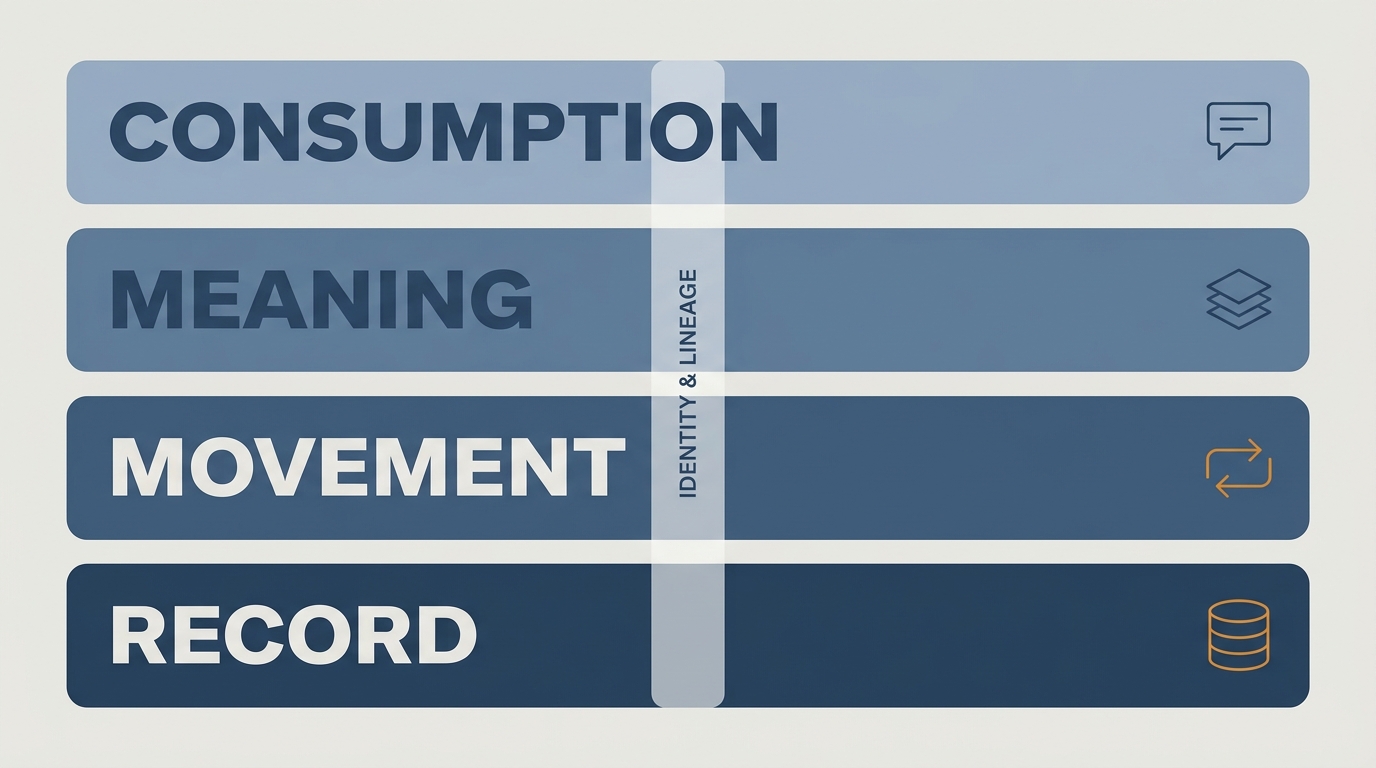
A four-layer model for AI-ready HR integration
This is the model I use to assess a landscape before anyone writes a prompt. The value is in the test column: each layer has one question that reveals whether it is genuinely ready.
| Layer | What it owns | Typical SAP components | Readiness test |
|---|---|---|---|
| 1. Record | Where a fact is created and approved | EC (person, employment, job info), S/4HANA (cost centre, org unit, Business Partner) | Can you name exactly one owning system per attribute, in writing? |
| 2. Movement | Getting facts across the boundary | Compound Employee API, BIB, CPI iFlows, IDoc, OData, SOAP | Can you replay yesterday’s 14:00 payload, unchanged, today? |
| 3. Meaning | Canonical model, ID crosswalk, time slices | CPI value mappings, staging tables, HANA Cloud / Datasphere | Can you answer “who was this person’s manager on 12 March” without a restore? |
| 4. Consumption | Analytics, agents, copilots, RAG | Joule, SAC, custom agents, BTP services | Does the consumer inherit EC role-based permissions, or does it see everything? |
Most landscapes score well on layer 1, adequately on layer 2, and fail on layers 3 and 4. That failure is invisible until an AI use case exposes it.
The integration replay test
Pick your busiest HR interface. Answer these six questions with evidence, not memory:
- Is the outbound payload persisted somewhere I can retrieve for a named date and time?
- If I resend it, is the receiving system idempotent, or do I create a duplicate?
- Can I distinguish a record that changed from a record that became effective?
- Is every identifier in the payload resolvable to a single person across EC, S/4HANA and the identity provider?
- When this interface fails a business rule (not an HTTP error), who finds out, and how fast?
- If a person is deleted or anonymised in EC, what happens downstream?
Fewer than four confident yeses means the AI conversation is premature. That is not a reason to stop — it is a scoped, fundable piece of work with a clear finish line.
Implementation patterns that matter
Choose the extraction contract deliberately
The CompoundEmployee API is SOAP-based and returns all requested time slices for an employee in a single hierarchical response, which is why it remains the right tool for replication to SAP follow-on systems (SAP Help Portal). OData v2 is better for narrow, entity-level reads and for anything interactive.
Two pitfalls worth stating plainly:
- Delta mode depends on auditing. Delta transmission relies on auditing having been switched on during system setup, before the initial employee load. Retrofitting it is painful. Confirm this before you design around delta.
- Pure delta misses future-dated changes. A change entered last week and effective next quarter will not reappear in a
lastModifiedDatedelta window when it becomes effective. Period-based delta (periodDeltawithfromDate/toDate) exists precisely for this. Landscapes that use plain delta and then reconcile with a weekly full extract are paying twice for a problem that has a supported answer.
Treat identity as a first-class integration object
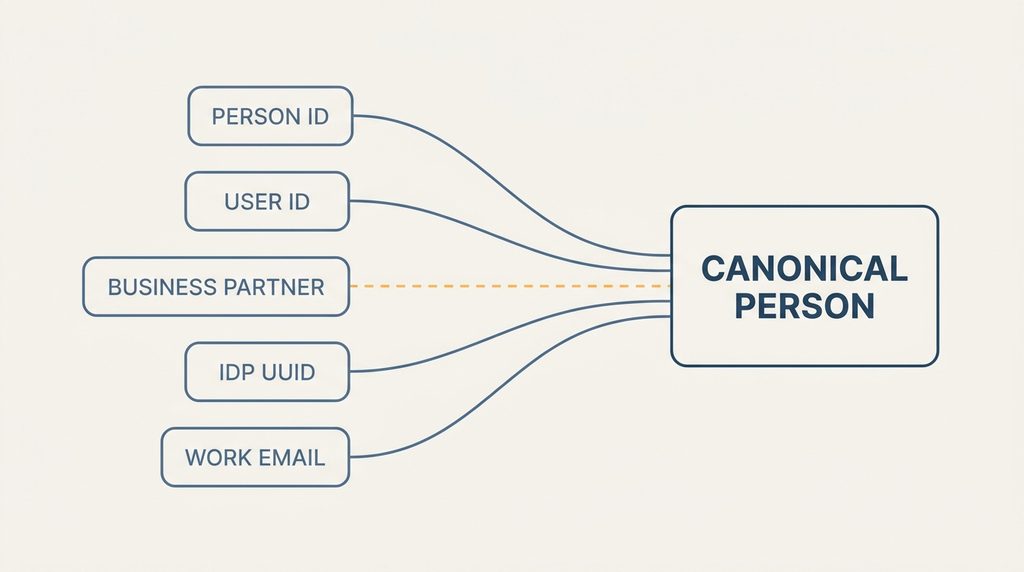
personIdExternal, userId, the S/4HANA Business Partner number, the IAS user UUID and work email are five identifiers with five different lifecycles. Build the crosswalk as a governed artifact — a versioned table with an owner — not a spreadsheet on someone’s laptop.
Concurrent employment and global assignments break the one-person-one-record assumption most consumers hold. Decide early whether your canonical model is person-centric or employment-centric, and enforce it. Retrofitting this is the single most expensive rework I see.
Separate machine identity from user identity
Use OAuth 2.0 SAML Bearer Assertion for CPI-to-SuccessFactors service calls, with a dedicated technical user scoped by a least-privilege role-based permission role. Use IAS/IPS for provisioning and SAML for interactive SSO. Reusing the interactive SSO configuration for service calls is a common shortcut that produces audit findings and an unpleasant expiry incident roughly a year later.
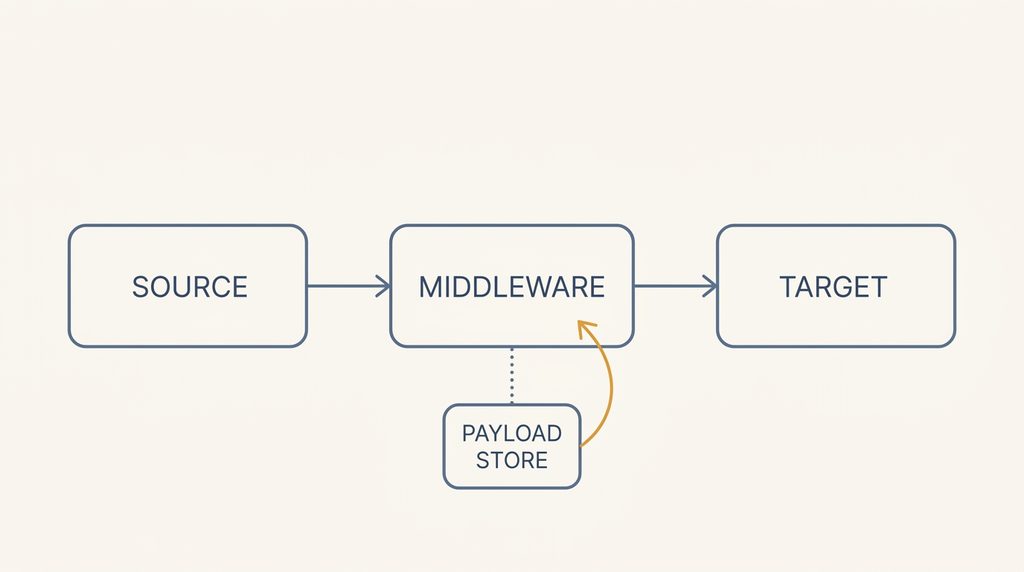
Do not let CPI be the system of record for errors
Persist payloads outside the message monitor. Use JMS queues for controlled retry rather than reprocessing from source. Alert on business-rule failures — a cost centre that does not exist in S/4HANA, an employee replicating without an org assignment — not only on HTTP status codes. A green interface delivering wrong data is worse than a red one.
An anonymised outcome
A composite of engagements I have worked on, rounded and generalised: a multi-country manufacturer, roughly 40,000 employees across nine countries, EC to S/4HANA replication plus three downstream consumers. Baseline was around 20 interface incidents a week, most surfaced by HR business users days later, and a recurring reconciliation effort of several person-days a month.
The changes were unglamorous: period-based delta on the extraction, a governed ID crosswalk, payload persistence with replay, and business-rule alerting. Incident volume fell by roughly two-thirds within a quarter, and mean time to detect moved from days to minutes. No AI was involved. The AI use case that followed took weeks instead of quarters, because the data questions were already answered.
Risks and governance the integration layer actually controls
Three things sit squarely with integration architects, not with the AI team:
- Field-level suppression at the source. If the extraction contract does not need health, union membership or ethnicity data, do not extract it. Suppressing a field in the request is cheaper and more defensible than masking it in four downstream systems.
- Lineage as an artifact. Record-keeping obligations are satisfied by persisted payloads and interface logs, not by good intentions. Retention periods for those logs need a decision and an owner.
- Permission inheritance. An agent that reads a flattened HR table has, in effect, unrestricted role-based permissions. Decide how EC permissions propagate to layer 4 before the first pilot, not after.
How to apply this: a first 30 days
Days 1–5 — Inventory. List every HR interface with source, target, protocol, frequency and business owner. Most organisations discover two or three interfaces nobody claims.
Days 6–15 — Run the replay test. Score your top five interfaces against the six questions above. Publish the scores. This converts a vague “our data is messy” into a specific backlog.
Days 16–22 — Fix identity. Produce the ID crosswalk and assign it an owner. Resolve the person-versus-employment question in writing.
Days 23–30 — Instrument, then scope. Add payload persistence and business-rule alerting to the highest-volume interface. Only then scope the AI use case, and scope it against layers 1–3 you have just measured.
Key takeaways
- AI readiness in HR is an integration property, not a model property. Effective dating and identity resolution decide whether an AI answer is defensible.
- Assess in four layers — record, movement, meaning, consumption — and test each with one hard question.
- If you cannot replay yesterday’s payload, you cannot audit an AI-assisted decision that used it.
- Period-based delta and auditing-before-initial-load are design decisions, not configuration details.
- Machine identity and user identity need separate configurations; conflating them is a deferred incident.
- The unglamorous work — crosswalks, payload persistence, business-rule alerting — is what makes the interesting work fast.
Further reading
- Compound Employee API extraction patterns and transmission modes on SAP Help Portal
- The text of Annex III of the EU AI Act, including point 4 on employment and workers’ management
- The NIST AI Risk Management Framework for a governance vocabulary that maps cleanly onto integration controls

3 thoughts on “Designing an AI-Ready HR Integration Architecture with SAP SuccessFactors and S/4HANA”