
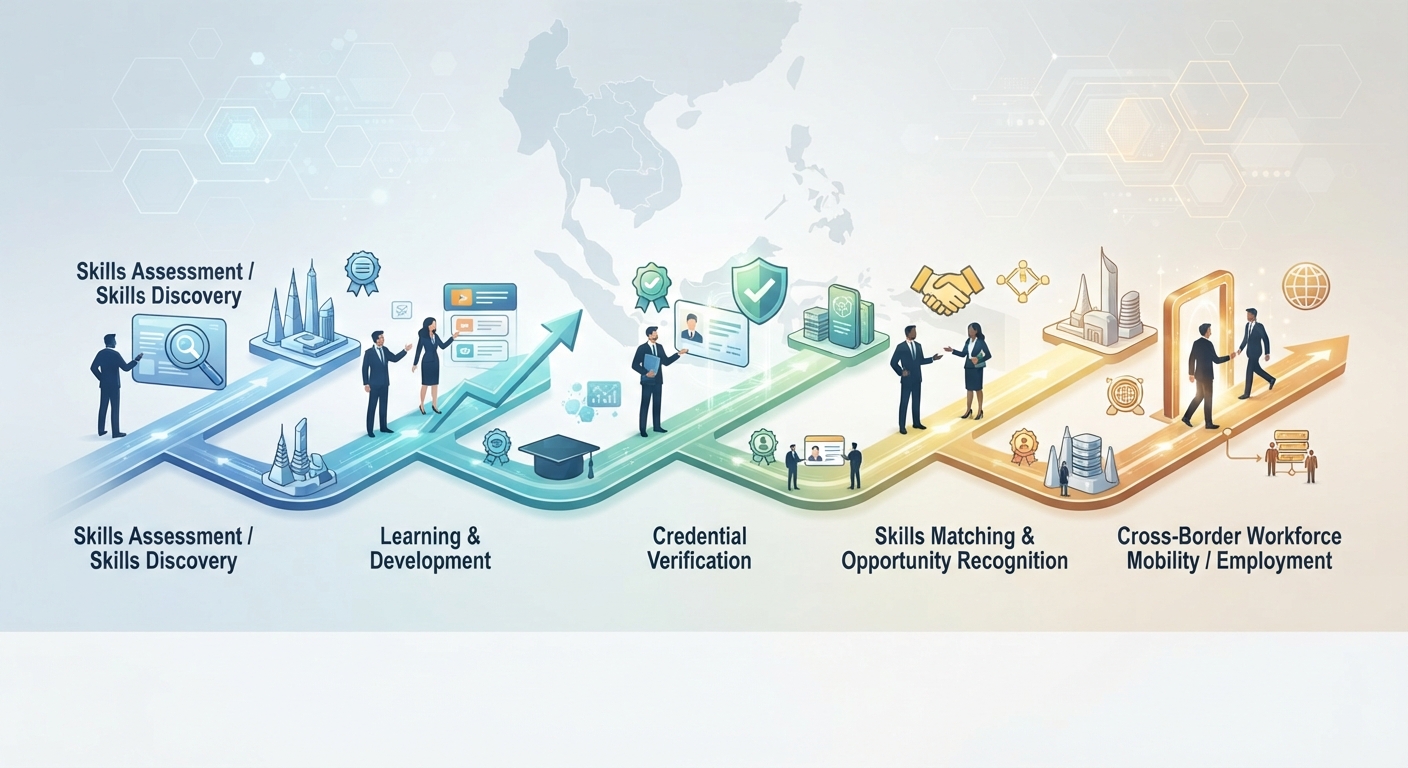
A hiring manager in Singapore receives a vocational welding certification issued in Malaysia. Can she quickly verify its quality? Does she understand what the qualification actually represents? Can she compare it fairly with internal job requirements, or must she treat it with suspicion because it comes from another country?
This everyday hiring challenge is about to change. In August 2026, labour ministers across Southeast Asia signalled a strategic shift toward stronger skills certification, comparability, quality assurance, and cross-border recognition. This is not an instant “one certificate accepted everywhere” system. It is a strategic move toward making skills easier to understand, trust, verify, and use across borders. For HR teams, this means new opportunities—and new responsibilities.
What Happened in Bangkok in August 2026?
On 26 August 2026, the 29th ASEAN Labour Ministers’ Meeting convened in Bangkok, Thailand. The following day, 27 August, the 14th ASEAN Plus Three Labour Ministers’ Meeting took place, bringing together ASEAN Member States, China, Japan, and the Republic of Korea.
Both meetings focused on workforce challenges and opportunities. The official theme of the ASEAN Plus Three meeting was explicit: “Advancing ASEAN Human Capital: Skills Certification towards Global Recognition.”
This is significant. When 10 nations and three regional powers align around skills certification, it signals a policy direction—not a completed system, but a commitment to strengthen how qualifications are understood, verified, and recognised across borders.
The meetings addressed broader workforce topics: AI and automation, green-economy transitions, worker inclusion, future-of-work preparedness, and social dialogue. But the emphasis on skills certification and recognition points to a specific pain point: Southeast Asian workers and employers need clearer pathways to understand, verify, and trust qualifications across national boundaries.
What Does “Skills Certification Towards Global Recognition” Actually Mean?
Let’s define the language, because clarity matters for HR teams.
| Term | Simple Meaning | Why HR Teams Care | Example |
|---|---|---|---|
| Skills certification | A formal document or credential proving someone has learned and demonstrated a specific capability | You need to know who actually has the skills for a role, not just a job title | SAP Integration certification; welding; AI data-analysis badge |
| Credential | The proof itself—a certificate, badge, license, or verified record | It’s the evidence you check when hiring or internal staffing | Digital badge from LinkedIn Learning; SAP certificate; nursing license |
| Qualification | A broader achievement, often combining skills, knowledge, and experience | Used in hiring and succession planning | Diploma in HR Management; Advanced Diploma in Manufacturing |
| Verification | Confirmation that a credential is genuine and current | You don’t hire based on false claims; you avoid liability and reputational risk | Checking if a certificate was really issued by SAP; confirming it hasn’t expired |
| Recognition | Formal acceptance that a credential is legitimate and valuable | If Singapore recognises a Malaysian welding cert, employers can hire with confidence | A regulatory authority or employer accepting a foreign qualification |
| Comparability | Ability to understand how one credential relates to another across countries | When hiring regionally, you compare “Malaysian TVET Level 3” to “Thai TVET Level 3” fairly | Using a common framework to say “these are roughly equivalent” |
| Quality assurance | Regular checks that qualifications being issued meet consistent standards | You trust all Malaysian welding certs because Malaysia’s system is audited | ASEAN bodies reviewing national TVET programmes for consistency |
| Mutual recognition | Two or more countries agreeing to accept each other’s credentials | Workers can move across borders; employers can hire without re-certification | Malaysia recognising Thailand’s crane-operator license |
| TVET | Technical and Vocational Education and Training | Southeast Asia produces millions of TVET graduates; their credentials need to travel | Diplomas from polytechnics, trade schools, skills institutes |
| Digital credential | A credential stored and verified online rather than as a paper document | Faster, more secure, easier to verify; supports AI-enabled skills matching | A blockchain-verified skills badge; a digital certificate in a cloud wallet |
The core idea: Skills matter more than job titles. But skills must be visible, comparable, verifiable, and portable for workers and employers to benefit from cross-border mobility.
What It Does NOT Mean: Myths vs. Reality
This is critical. ASEAN policy statements signal direction, not immediate legal transformation. Let’s separate myth from reality.
| Myth | Reality |
|---|---|
| “Every ASEAN certificate is now automatically recognised everywhere.” | Recognition is sector-specific, credential-specific, country-specific, and employer-specific. A Malaysian welding certificate may be recognised for welding roles but not automatically for all employment purposes. National qualification frameworks still apply. |
| “A digital badge is always verified and trustworthy.” | Digital credentials still require a legitimate issuer, verification mechanism, and quality assurance. A fake digital badge is still fake. Employers must validate the source. |
| “Employers no longer need to check candidate qualifications.” | Employers remain responsible for verifying credentials, assessing fit, and confirming legal eligibility to work. AI may speed up verification, but human judgment is not replaced. |
| “Skills-based hiring means degrees no longer matter.” | Skills-based hiring means considering multiple forms of evidence: degrees, certifications, experience, demonstrated capability, project work. Degrees remain valuable; they’re part of a richer picture. |
| “AI can independently approve cross-border hiring decisions.” | AI can surface qualified candidates, flag skill gaps, and accelerate matching. Humans must approve hiring decisions, especially across borders where legal, visa, compliance, and fairness issues are complex. |
| “An ASEAN policy statement automatically changes immigration and work-pass rules.” | Immigration, work visas, tax, and employment law remain national decisions. ASEAN labour-minister talks do not override national sovereignty. Changes happen through bilateral agreements or national policy reform. |
| “This means a single ASEAN job certificate that opens doors everywhere.” | This means stronger processes for comparing, verifying, and recognising credentials. Many credentials may remain country-specific or require additional licensing (e.g., medical professionals, engineers). |
Why This Matters to HR Leaders Now
Cross-Border Recruitment and Talent Mobility
ASEAN economies are increasingly interconnected. A Singapore tech company may recruit from Malaysia, Thailand, and Vietnam. A Thai manufacturer may open a facility in Indonesia. When hiring across borders, HR teams currently face friction: qualifications are hard to compare, verification takes time, and trust is low. Stronger skills certification reduces that friction.
Faster Understanding of Skills in Multi-Country Hiring
Instead of trying to interpret “Malaysian Diploma in IT,” an HR system could reference a common competency framework. Instead of manually verifying a PDF certificate, an employer could quickly check a verified digital record. This speeds hiring, especially for technical and skilled roles.
Skills-Based Workforce Planning
Many ASEAN companies organise work by job title. SAP SuccessFactors, for example, excels at organisational hierarchy but often lacks deep skills data. Skills certification pushes companies toward a richer model: “What capability do we need?” not just “What title do we need filled?”
Learning and Reskilling for AI, Digital, Green, and Technical Roles
ASEAN is under pressure to upskill workforces for AI, digital transformation, and green-economy transition. Stronger skills certification means:
- Workers can see clear pathways to acquire recognised credentials.
- Employers can track which employees have verified skills in emerging areas.
- Learning providers can align curriculum to industry-recognised standards.
- Governments can match workforce data to economic priorities.
Verification, Compliance, Audit Readiness, and Credential Expiry Tracking
Many credentials expire (certifications, licenses, training completion). In a skills-based model, HR systems can track expiry dates and flag when renewal is required. This is essential for regulated roles (healthcare, aviation, workplace safety) and increasingly important for technical certifications (cloud, cybersecurity, AI).
Better Alignment Between Employers, Education, TVET, and Public Employment
When skills are verifiable and portable, educational institutions, TVET systems, and employers can align. If employers clearly state “we need 1,000 welders with ISO certification,” TVET providers can build programmes to meet that need. Workers see a clearer return on training investment.
More Equitable Pathways for Workers Without University Degrees
ASEAN has a huge population of TVET graduates and self-taught professionals. Stronger skills certification means their capabilities are recognised without requiring a university degree. This is economically and socially important for social mobility and workforce inclusion.
Regional HR Systems Integration
Companies with operations across multiple ASEAN countries face data fragmentation. If Malaysia uses one skills framework and Thailand another, an integrated HRIS becomes harder to build. Stronger comparability reduces that fragmentation.
How This Affects HR Teams Across ASEAN
| Country/Market | Likely HR Relevance | Practical HR Question |
|---|---|---|
| Malaysia | TVET is large sector; Malaysia emphasises skills harmonisation and future-oriented roles (AI, robotics, EV). Strong manufacturing base. | Which skills are critical for next 3 years? Are we tracking certifications and expiry? Can we match job roles to verified skills? |
| Singapore | Highly mobile workforce, significant foreign workers, strong tech and finance sectors. Needs clarity on overseas credentials. | Can we quickly verify credentials from Malaysia, Philippines, India? Do we have a skills taxonomy for internal mobility? |
| Thailand | Large manufacturing and logistics base, growing digital economy. Significant regional employment hub. | Do we understand Thai vocational qualifications? Can we hire skilled workers from other ASEAN countries with confidence? |
| Indonesia | Huge workforce, diverse skill levels, rapid economic change. Informal sector significant. | How do we identify and verify skills in a large, dispersed workforce? Can regional hiring help address skill shortages? |
| Vietnam | Fast-growing manufacturing and tech sectors, large diaspora. Competing for regional talent. | Are we structured to attract talent from other ASEAN countries? Do we have tools to assess and verify skills? |
| Philippines | Large services and BPO sector, significant overseas workers, strong talent for remote roles. | How do we upskill and certify our workforce for higher-value roles? Can we leverage cross-border recognition to improve career pathways? |
| Other ASEAN Markets | (Cambodia, Brunei, Laos, Myanmar) | Skills certification can help smaller economies tap into regional talent networks and attract regional investment in sectors like tourism, manufacturing, and services. |
Malaysia’s Emphasis: TVET Harmonisation and Future Skills
Malaysia has emphasised several priorities within the ASEAN skills-certification discussion:
According to the Bernama report, Malaysia has called for:
- Joint certification and harmonisation of TVET qualifications across ASEAN, so Malaysian TVET is understood and valued across the region.
- Technology transfer and instructor upskilling, so TVET educators in ASEAN keep pace with industry change.
- Future-oriented skills development in artificial intelligence, robotics, next-generation vehicles, and green energy.
These priorities reflect Malaysia’s position as a manufacturing hub and tech investor. If ASEAN agrees to recognise Malaysian TVET credentials more widely, Malaysian workers gain mobility. If Malaysia can influence regional skills standards, Malaysian industry gets a pipeline of regionally-trained workers.
For Malaysian HR teams, this means:
- Internal question: Which of our workforce skills are strategically critical? AI? Data? Cybersecurity? Manufacturing automation?
- Verification question: Are we tracking who has verified certifications in these areas?
- Structural question: Can we map job roles to skills, learning pathways, and certification requirements?
- Compliance question: Can we track credential expiry and renewal?
The HR Technology Challenge: From Job Titles to Verified Skills
Many ASEAN companies, even large ones, have not yet moved to skills-based HR. Their systems still organize work primarily by job title.
Why This Falls Short
- Job title does not reliably show capability. A “Senior Manager” title doesn’t tell you if the person has AI knowledge, project-management certification, or language skills.
- CVs and PDF certificates are difficult to search, compare, verify, and analyse. HR searches might find “5 years experience in SAP SuccessFactors,” but cannot easily identify “verified SAP BTP integration certified resources available for a project in Singapore next quarter.”
- Skills may be self-declared, outdated, duplicated, or disconnected from job architecture. An employee may claim “fluent in Python,” but does the company have evidence? Is it current? Has it been tested?
- Different business units and countries may use different names for similar roles. One unit calls someone a “Business Analyst,” another calls the same role “Solutions Consultant.” Comparing skills across the company is impossible.
- HRIS, LMS, recruiting systems, certification repositories, and document systems are often disconnected. Skills data lives in isolated silos. No unified view of workforce capability exists.
The Skills-Based Model
A skills-based approach requires:
| Dimension | Traditional HR Data Model | Skills-Based, Credential-Aware Model |
|---|---|---|
| Primary organiser | Job title, reporting structure | Skill, proficiency level, verified certification |
| Evidence | CV (unverified PDF) | Structured skill profile + verified credentials + learning records + project evidence |
| Credential tracking | Manual spreadsheet or lost in HR files | Automated tracking with expiry alerts and renewal workflow |
| Cross-country comparison | “Is a Thai diploma equivalent to a Malaysian one?” Unknown. | Mapped to common competency framework; comparability clear |
| Skill currency | Unknown; assumed stale | Learning records, project work, and certification dates show current capability |
| Internal mobility | Succession planning based on titles | Skills-gap analysis; employees matched to opportunities based on capability |
| Learning targeting | One-size-fits-all training | Personalised learning paths based on verified skills, gaps, and career goals |
| AI/Agent readiness | Systems cannot surface qualified candidates at scale | AI can match people to opportunities, projects, and learning based on structured skills data |
Where AI and MCP Agents Can Help
AI and integration technology can accelerate the shift toward skills-based HR. But it’s important to understand what these tools can and cannot do.
Model Context Protocol (MCP) is a technical standard that allows AI systems to safely access approved tools and data sources—like your HRIS, learning system, credential repository, and policy knowledge base—in a controlled, audited way. MCP is not a labour-policy mechanism. It is an architecture for integrating systems and enabling AI agents to work with company data responsibly.
A Governed Workflow Example: Cross-Border SAP Integration Talent Matching
Imagine this scenario:
A Singapore-based business unit needs an SAP BTP Integration architect for a regional cloud-migration project. The company wants to find qualified internal candidates across Malaysia, Thailand, Indonesia, Vietnam, and the Philippines. Normally, this would require:
- Manual emails to HR business partners in each country.
- Spreadsheet collation of candidate names.
- Calls and meetings to discuss qualifications.
- Uncertainty about whether credentials are verified.
- Weeks of coordination before a shortlist emerges.
With a governed AI/MCP agent approach:
- Read the approved role profile: The agent retrieves the job description from HRIS, which specifies: “SAP Certified – Solutions Architect – SAP BTP” (required); “5+ years integration experience” (preferred); “English language proficiency” (required); “Available for relocation or remote work” (preferred).
- Retrieve structured skills and credentials: The agent queries the HRIS across all connected entities, pulling: certified skills (with issuer, date, expiry), project history, language capabilities, location, visa/work-pass status, mobility preferences, and availability.
- Identify verified vs. self-declared: The agent flags which evidence is verified (SAP certification, LMS completion record) and which is self-declared (“fluent in Python” mentioned in a CV).
- Highlight gaps and blockers: The agent identifies candidates who meet core requirements but flags gaps: “Certified in SAP S/4HANA, not SAP BTP”; “Visa sponsorship required for Singapore relocation”; “Certification expires in 3 months—renewal needed.”
- Produce a ranked shortlist with explanations: The agent presents 5–10 candidates ranked by match quality, with clear reasoning: “Candidate A: 100% match (certified BTP, 7 years experience, English fluent, available immediately); Candidate B: 85% match (S/4HANA certified, willing to upskill BTP, requires visa sponsorship).”
- Send results to human decision-makers: The results go to the hiring manager and HR business partner. They review, ask follow-up questions, and decide whom to interview.
- Avoid automated final decisions: The agent does not decide who is hired, approve the hire, negotiate salary, arrange visa sponsorship, or determine compensation. Humans remain accountable.
Why This Matters for ASEAN Skills Certification
In this scenario, skills data is:
- Structured: Stored as data, not buried in PDFs.
- Verified: SAP certifications checked against official registries.
- Portable: Compared across countries using common criteria.
- Auditable: Decisions logged; reasoning transparent.
- Compliant: Subject to access controls, privacy, and consent.
As ASEAN strengthens skills-certification frameworks, employers with this level of data maturity will hire faster, more confidently, and more fairly. Those still relying on CVs and manual verification will fall behind.
Guardrails for Responsible HR Agents
AI agents in HR must operate under strict governance. This is not optional—it’s legal, ethical, and practical necessity.
Essential controls:
- Role-based access control. HR leaders see anonymised data; recruiters see only candidates they’re authorised to review.
- Least-privilege data access. An agent accessing skills data does not need access to salary, performance ratings, or disciplinary records.
- Consent and privacy requirements. Employees must consent to their skills data being used in matching workflows. Data collection must comply with PDPA (Malaysia) and equivalent privacy laws.
- Audit logs and explainability. Every agent action is logged: “Agent matched Candidate X to Role Y on Date Z with Reasoning R.” This log must be auditable by HR, legal, and compliance teams.
- Data-quality controls. Bad data → bad matches. Processes must validate skills data quality before agents use it.
- Human-in-the-loop approval. Agents recommend; humans decide. No automated hiring, termination, pay decisions, discipline, visa sponsorship, or regulated-profession equivalence determinations.
- Bias testing and ongoing monitoring. Does the agent match candidates fairly across gender, nationality, age, background? Regular testing and monitoring are required.
- No automated final decisions. Explicitly prohibit agents from making autonomous decisions on: hiring, termination, compensation, benefits, discipline, immigration/visa sponsorship, regulated-profession licensing, or sensitive workforce actions.
- Clear ownership. Who owns the agent? HR, IT, security, legal, compliance, data governance, or business leaders? Ownership must be clear, with defined escalation paths.
A Practical 90-Day Action Plan
If you’re an HR director, CHRO, or enterprise architect, here’s how to start:
| Timeframe | Action | Owner | Deliverable |
|---|---|---|---|
| Days 1–30: Assess and Baseline | |||
| Days 1–7 | Identify 3–5 critical job families affected by skill scarcity, regional mobility, or automation | CHRO + Business units | List of priority roles (e.g., SAP architects, data engineers, cyber analysts, technicians) |
| Days 8–14 | Create baseline inventory of systems: HRIS, ATS, LMS, recruitment platforms, document repositories, certification tracking, identity/access systems | HR Tech + IT | System inventory with data flows and integration points |
| Days 15–21 | Define minimum common skills and credential data model: skill name, proficiency level, certifier/issuer, date issued, expiry date, verified vs. self-declared flag | HR + Data governance | Skills taxonomy (100–200 core skills) and credential model (data structure) |
| Days 22–30 | Separate verified credentials (SAP certs, LMS completion, regulatory licenses) from self-declared skills (CV claims, manager assertions) | HR + Compliance | Data audit; identify where verification gaps exist |
| Days 31–60: Build Connectors and Governance | |||
| Days 31–40 | Map job roles to skills and proficiency levels required | HR + Business units | Role-to-skills matrix (e.g., “SAP Integration Architect requires: SAP BTP Certification (L3), Integration design (L4), Enterprise architecture (L3)”) |
| Days 41–50 | Connect HRIS, LMS, recruiting, and credential repositories through approved APIs or integration middleware such as SAP Cloud Integration or similar | IT + HR Tech | Data integration; real-time or batch sync of skills, certifications, learning records |
| Days 51–60 | Define credential-verification and expiry processes: who verifies? How often? What happens when a cert expires? Renewal workflow? | HR + Compliance | Credential verification SOP; expiry-tracking workflow; renewal notifications |
| Days 61–70 | Establish governance, data classification, and approval controls; define who can see what data, who approves matching recommendations | HR + IT Security + Legal | Data governance policy; access control matrix; approval process |
| Days 71–90: Pilot and Measure | |||
| Days 71–80 | Pilot a read-only skills-matching or talent-gap agent using MCP or approved integration pattern | HR Tech + IT | Agent prototype; test data; sample matching outputs |
| Days 81–90 | Measure: match quality, time saved vs. manual process, user satisfaction, data-quality gaps, exception rates; require HR review before any workflow change | HR + Analytics | Pilot report; decision to scale, redesign, or stop |
Frequently Asked Questions
1. What is ASEAN skills certification?
ASEAN skills certification refers to formal credentials (certificates, badges, diplomas) that prove someone has learned and demonstrated a specific capability. The ASEAN labour ministers’ 2026 initiative aims to make these credentials more comparable, verifiable, and recognised across Southeast Asia. This supports workers who want to move across borders and employers who want to hire regionally.
2. Will ASEAN certificates be automatically recognised in every country?
No. Recognition is sector-specific, credential-specific, country-specific, and employer-specific. A Malaysian welding certificate may be recognised for welding roles in Thailand but not automatically for all employment purposes. Regulated professions (medicine, law, engineering) may require additional country-specific licensing. Immigration, work visas, and employment law remain national decisions.
3. What does this mean for HR teams in Malaysia and Singapore?
For Malaysia, it means Malaysian TVET credentials are positioned to gain wider regional recognition, creating talent mobility opportunities. For Singapore, it means faster verification of credentials from other ASEAN countries, enabling regional hiring. Both countries benefit from clearer skills-data standards, which support internal mobility and cross-border project staffing.
4. How can employers verify employee credentials?
Employers can verify credentials through multiple methods: checking official issuer registries (SAP certification registry, for example), reviewing digital credentials with embedded verification tokens, contacting educational institutions directly, or using third-party credential-verification services. As ASEAN systems mature, digital verification will become faster and more reliable. HR systems should automate this process where possible.
5. What role can AI and MCP agents play in skills-based HR?
AI agents can accelerate skills-based HR by automatically matching people to opportunities, identifying skill gaps, flagging certification expiry, and surfacing qualified candidates. MCP (Model Context Protocol) is a technical standard that allows agents to access approved systems like HRIS, LMS, and credential repositories in a governed way. Agents improve discovery, matching, and workflow coordination—but humans must remain accountable for hiring, fairness, and compliance decisions.
6. Does skills recognition replace degrees and professional licences?
No. Skills certification complements degrees and licences; it does not replace them. A university degree, a vocational diploma, and professional certifications are all forms of credentials. Skills-based hiring considers multiple forms of evidence: formal education, certifications, demonstrated experience, and project work. Some roles will always require specific degrees or licences (engineers, doctors, lawyers), especially in regulated sectors.
7. What should HR teams do first?
Start with clarity: Which skills are strategically critical for your organisation? Do you have structured data on who has verified skills? Can you track credential expiry? Once you understand the baseline, begin connecting your HRIS, learning systems, and credential repositories so skills data flows reliably across systems. This foundation enables skills-based workforce planning and positions you to adopt AI-assisted matching when you’re ready.
Sources and Further Reading
- ASEAN Secretariat — 29th ASEAN Labour Ministers’ Meeting Joint Communiqué (26 August 2026, Bangkok, Thailand)
- ASEAN Secretariat — 14th ASEAN Plus Three Labour Ministers’ Meeting Joint Statement (27 August 2026, Bangkok, Thailand) — Theme: “Advancing ASEAN Human Capital: Skills Certification towards Global Recognition”
- ASEAN Official News — The 14th ASEAN Plus Three Labour Ministers’ Meeting Convenes Under the Theme “Advancing ASEAN Human Capital: Skills Certification towards Global Recognition”
- ASEAN Official News — The 29th ASEAN Labour Ministers’ Meeting Convenes in Bangkok, Thailand
- Bernama / ASEAN — Malaysia urges ASEAN to strengthen recognition of labour skills
- The Star Online — Malaysia and Thailand to modernise labour cooperation framework
- International Labour Organization (ILO) — Inclusive Policies and Social Dialogue Key to Navigating AI Transformation in Asian Labour Markets
Final Takeaway
ASEAN’s August 2026 discussions represent a strategic signal that workforce competitiveness will increasingly depend on skills that are not only learned, but also visible, comparable, verifiable, and portable. HR teams should not wait for a perfect regional standard to take action. The foundation is clarity and data integration: Can your HR systems show not only what job an employee has, but what verified skills they can use across a regional workforce?
The organisations that move first on skills-based HR and responsible AI integration will hire faster, retain talent more effectively, and compete better for regional talent. Those relying on CVs and manual verification will fall behind.
The next 90 days are the time to assess, baseline, and begin connecting your systems. The next year is the time to pilot and scale. By 2027, skills-based, credential-aware HR will be a competitive advantage across ASEAN.
