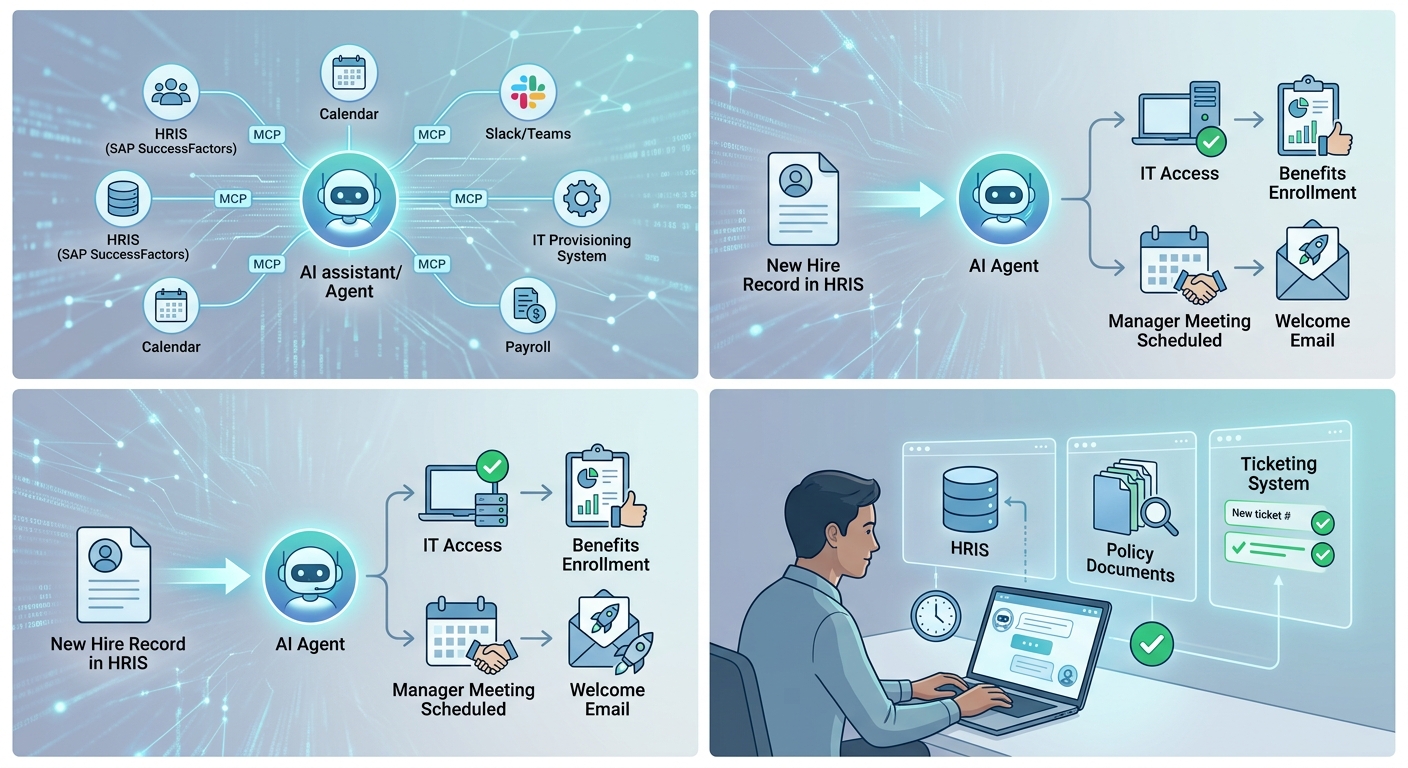
Hypothetical scenario: An AI agent updates an employee’s job record. For instance, the request is legitimate. Similarly, the permissions are valid. A system records the approval. However, the downstream payroll update fails. Is the task complete, and who owns the exception?
To be clear, this is a thought experiment, not a reported customer incident. As of this writing, no specific SAP SuccessFactors or Workday customer has publicly described such a failure. However, the scenario is useful. Specifically, it isolates a question that two of the largest HR platform vendors raised in the past week. In addition, it builds on the broader shift from agentic HR pilots to production workflows.
First, consider SAP. On October 12, 2026, SAP announced an HR Operations Assistant for the SuccessFactors 2H 2026 release. The assistant proactively resolves “workforce and payroll data issues.” It also automates “employee and job changes” and position management. In addition, it can “detect approval bottlenecks, nudge approvers, and recommend next steps” (SAP News Center, October 12, 2026).
Next, consider Workday. On October 13, 2026, Workday announced its Trusted Agent Platform. The company told customers that agent actions “work under the same Workday permissions, approvals, and audit trails.” Additionally, Workday introduced Agent-Ready Tools. These are “Workday’s Model Context Protocol (MCP) tools” that give “any agent that supports MCP an approved way to read Workday data and take action” (Workday Investor Relations, October 13, 2026).
The Central Question
Both vendors describe capable, well-permissioned agents. However, neither announcement answers one organizational question on its own. Who in the enterprise is accountable for an agent identity acting under its own credentials? This matters when a permitted agent action produces the wrong business outcome. It also matters when the HRIS transaction is clean but a downstream step quietly fails.
In this article, we examine that HRIS accountability gap. In short, existing permissioning and audit controls are necessary. However, without a deliberate accountability design, they are not yet sufficient.
What SAP and Workday Actually Announced
Overall, the announcements overlap on direction and differ on scope. The table below separates what is generally available today from what the vendors are positioning for later.
| Vendor | Capability | Status as announced | Source |
|---|---|---|---|
| SAP | HR Operations Assistant for SuccessFactors (data issues, approvals, position and job changes) | Part of the 2H 2026 release, “delivered throughout the remainder of the year”; specific tenant eligibility and ship dates not stated | SAP News Center, Oct 12, 2026 |
| Workday | Agent Harness; agents operate under existing Workday permissions, approvals and audit trails | Generally available | Workday press release, Oct 13, 2026 |
| Workday | Agent-Ready Tools (MCP), Custom Agents, Developer Agent | Generally available in Workday Extend AI | Same as above |
| Workday | Agent Context Service | Early access expected late 2026; GA early 2027 | Same as above |
| Workday | Grounded Reasoning | Early access expected early 2027 | Same as above |
| Workday | Support for Google ADK | Accepting design partners (not GA) | Same as above |
Three observations follow. First, the control substrate is largely vendor-side. It covers identity, approval chains and audit logs. Second, several components most relevant to trusting an agent’s reasoning are future-dated. Workday’s Agent Context Service and Grounded Reasoning are the clearest examples. Per Workday’s own forward-looking statement, these features are “subject to change at Workday’s discretion and may not be delivered as planned or at all.”
Third, feature availability depends on edition. For example, several Workday components ship inside Workday Extend AI. In SAP’s case, availability also depends on how the 2H release rolls through tenants. Therefore, buyers should separate the roadmap from what their tenant actually gets this quarter.
Permission Is Not the Same as Correctness
An AI agent operating under correct Workday or SuccessFactors permissions is doing what it is allowed to do. That is a necessary control. However, it is a control over scope, not over truth. Still, a policy-compliant action can be the wrong business decision. For example, it may use the wrong effective date, the wrong grade, the wrong cost center, or the wrong employee.
NIST’s generative AI profile names this risk directly. It defines confabulation as GAI systems producing “confidently present erroneous or false content in response to prompts.” In addition, it warns of automation bias, which it describes as “excessive deference to automated systems.” As a result, humans may over-rely on confident AI output (NIST AI 600-1, July 2024, sections 2.2 and 2.7).
The document is voluntary, cross-sectoral guidance on managing generative AI risk. It is not HR-specific law. However, the risks it names are directly relevant. For example, a manager may click “approve” on an agent-proposed job change without the time, context or evidence to validate the proposal. In that case, the manager is not providing meaningful oversight. They are providing a signature.
OWASP’s LLM06:2025 Excessive Agency entry treats this as a design problem rather than a user problem. Its recommendations are specific. First, limit “the extensions that LLM agents are allowed to call to only the minimum necessary.” Second, limit “the permissions that LLM extensions are granted to other systems to the minimum necessary.” Third, use “human-in-the-loop control to require a human to approve high-impact actions before they are taken” (OWASP Gen AI Security Project, LLM06:2025).
In short, approval is only one leg of the control. Minimum-necessary scope is the other.
Auditability Is Not the Same as Assigned Accountability
Workday’s statement that agents operate under existing “approvals, and audit trails” is accurate and valuable. An audit trail answers what happened, when, and under which identity. However, it does not answer two different questions. First, who was responsible for allowing this class of action? Second, who owns resolving its consequences?
Instead, those are organizational decisions, not log fields. An action logged against a service principal does not assign accountability to a named role on its own. The organization must first define the mapping. For example, this product owner operates this agent in this scope. The product owner works under policy approved by this governance body. In addition, exceptions route to this named owner.
Without that mapping, teams will investigate a cleanly logged bad outcome. Then they will loosely blame “the agent.” Finally, someone will quietly rerun it.
Two Hypothetical Failure Paths
The following are illustrative, not reported.
Path A — Permitted but incorrect change. First, an agent receives a request to backdate a job change to the start of the previous pay period. The agent’s permissions permit effective-dated changes. Next, the approver sees a confident recommendation and a plausible rationale. The approver approves. Then, the HRIS writes the record. Soon after, payroll re-runs retroactive calculations. Two pay periods later, an employee notices an unexpected gross-to-net difference. Meanwhile, the audit trail shows a clean, permitted, approved transaction. However, it does not show that the proposed effective date was wrong.
Path B — Correct HRIS change, failed downstream execution. First, an agent correctly updates a cost-center change in the HRIS. Shortly after, the HRIS confirms success. However, a middleware integration to a time-and-attendance system quietly fails after two retries. The agent emitted its “task complete” message on HRIS acknowledgement, not on downstream reconciliation. As a result, for six weeks, the system charges labor to the old cost center. Meanwhile, the audit trail in the HRIS is clean. In other words, the failure sits in a different system.
Both paths are consistent with risks NIST discusses under value chain and component integration (section 2.12). In that section, NIST observes that third-party components and integrated systems can obscure accountability for downstream users. Admittedly, traditional HR middleware has similar failure modes. In other words, AI agents do not invent the problem. However, they do compress the time between request and action. As a result, the premium on fast, trustworthy reconciliation rises.
A Four-Layer Accountability Framework
Therefore, to close the gap, organizations can treat an agent-initiated HR change as a chain of four questions. Each question carries its own control.
- Authorization. Is the agent identity, scope and action type permitted for this request? In practice, vendor controls do most of this work.
- Business validity. Is the proposed change factually correct given policy, employment contract, local law and the employee’s current record state? A rules layer checks each one, and an evidence package records the result.
- Outcome verification. Did the end-to-end process reconcile successfully? This covers the HRIS write, downstream integrations and calculated effects. Reconciliation plus exception detection.
- Accountability. Which named role is answerable for allowing this scope, approving this instance and resolving an exception? Documented in advance.
Layers 1 and 2 tend to fail safe. Typically, the change does not happen. However, layers 3 and 4 are where accountability most often leaks. Specifically, by the time a problem surfaces, the agent and its approver are three steps removed from the consequence.
A Proposed HR Agent Accountability Matrix
Overall, the following matrix is illustrative. Role names must be adapted to each organization’s structure. Its point is simple. First, resist the common failure mode of listing an “AI governance committee” as accountable on every row. In practice, that is the same as no one being accountable.
| Activity | Illustrative accountable role | Evidence captured | Escalation owner |
|---|---|---|---|
| Defining allowed agent scopes (which actions, which fields) | HRIS Product Owner, with HR Compliance sign-off | Versioned scope document | HR Operations Director |
| Approving an individual agent-proposed change | Line manager or HR Business Partner, per policy | Approver identity, evidence pack, timestamp | Regional HR Lead |
| Monitoring downstream reconciliation (HRIS to payroll, time, benefits) | Integration Operations Lead | Reconciliation report per cycle | Payroll Manager |
| Investigating and classifying agent-related exceptions | HR Operations Incident Manager | Incident record, root cause, remediation | HR Operations Director |
| Reviewing cumulative agent behavior (overrides, drift, false positives) | HR AI Governance Lead | Monthly agent-behavior review | CHRO or delegate |
| Agent identity, credentials and permission lifecycle | Identity and Access Management | IAM change log | CISO |
In short, the purpose is specificity. Diffuse accountability will not be exercised.
What Evidence Should Accompany an Agent-Assisted Change?
We recommend the following fields. Vendors do not guarantee them as log fields. Some will come from the HRIS. Others will come from the agent framework or middleware. In addition, control access to the resulting record. The record should also carry an organization-defined retention period.
- Request identifier and requester (human or upstream system).
- Agent or service identity and relevant model or version.
- Authorized scope at time of action.
- Exact proposed field changes and effective date.
- Policy and rule references consulted; validation results.
- Approver identity, time, and the specific transaction scope approved.
- Tool or API call and transaction identifiers.
- Source-system response (success or failure codes, record IDs).
- Downstream acknowledgement and reconciliation status, per connected system.
- Named exception owner, when the chain did not complete cleanly.
- Recovery decision and final outcome.
Never store some fields. These include raw credentials, unbounded prompt or completion text, full employee records beyond the purpose of the action, and hidden chain-of-thought reasoning. In addition, apply field-level redaction consistent with data-privacy obligations. Also, define which roles can read each class of evidence. For a useful reference, see NIST AI 600-1 section 2.4 on data-privacy considerations in generative systems.
Proposed Test Scenarios
Here is a compact starter set. The expected control behavior is a design assertion for your implementation. It is not a vendor guarantee.
| # | Scenario | Expected control behavior |
|---|---|---|
| 1 | Ambiguous request (“adjust Priya’s salary soon”) | Agent refuses to execute; requests structured input or routes to a human. |
| 2 | Wrong effective date proposed (prior to legal start date) | Business-validity layer blocks the change before approval. |
| 3 | Employee record changes after approval but before execution | Agent re-validates against current state; re-approval is required. |
| 4 | Duplicate retry after a timeout | Idempotency key prevents a second write; event is logged. |
| 5 | Permissions revoked between proposal and execution | Action is rejected at execution time; exception owner is notified. |
| 6 | Downstream payroll rejection after HRIS success | Outcome-verification layer opens an exception; status does not report “complete.” |
| 7 | Incomplete success message from agent | Reconciliation detects the gap and overrides the agent’s self-report. |
Of course, teams should run these scenarios on their own configuration. The point is not whether a vendor “passes” or “fails.” Instead, the point is to confirm that each layer behaves as the policy says it should.
Recovery Is Not Rollback
A corrective transaction, a compensating action and a technical rollback are not interchangeable. In addition, HR data rarely supports a simple undo.
- A corrective transaction records a new effective-dated change that restores the prior state going forward.
- A compensating action addresses downstream effects. For example, re-run payroll, issue an adjustment, correct benefits enrolment, or file an amended statutory return.
- A technical rollback reverts a database state. However, it is rarely available for payroll or distributed HR processes once calculations have run, statements have been issued or ledgers have been posted.
Agent frameworks sometimes imply “undo” through friendly language. However, test any such claim against the specific downstream systems involved. In particular, test against statutory reporting cadences in each jurisdiction. Finally, OWASP’s recommendation to “log and monitor the activity of LLM extensions and downstream systems” is a prerequisite to attempting the right compensating action (OWASP LLM06:2025).
Practical Implementation Priorities
For the next two quarters, teams working with SAP SuccessFactors, Workday or both can prioritise work that does not depend on specific vendor roadmap items.
- Write the scope documents. Define, per agent, which actions, fields and effective-date ranges are permitted. Review quarterly, alongside any cutover-readiness gating you already run.
- Draft the accountability matrix. Pick named roles, not committees.
- Instrument downstream reconciliation. Treat “HRIS acknowledged” as a milestone, not a terminus.
- Rehearse the exception process. Walk through a Path A and a Path B scenario in a tabletop. Then confirm who is called.
- Separate approval from evidence. Require every human approval to carry an evidence pack the approver can read in under two minutes.
- Decide what you will not automate. Risk-based automation is sensible. However, blanket automation of actions whose exceptions you cannot recover from is not.
Independent evidence of agent misbehavior inside nominal scopes continues to accumulate. For example, a Q3 2026 community roundup from the OWASP Gen AI Security Project catalogues several cases from the broader AI ecosystem (OWASP, October 8, 2026). However, the document itself notes it is not exhaustive. It is also a community document rather than an official OWASP publication.
The incidents it describes are in security contexts, not HR operations. Therefore, they should not be read as HR failure reports. Nevertheless, they underline the general point. Permission-correct behavior and desirable behavior are not the same thing.
Conclusion: The Decisions an Organization Must Make
The SAP and Workday announcements are helpful. However, they do not resolve how an enterprise assigns responsibility when an agent-assisted change goes wrong. In fact, they were not written to. Instead, that work is for the enterprise.
Each organization adopting agentic HR capabilities should decide the following in advance of production use:
- which actions an agent may initiate;
- which actions require human approval, and what evidence that approval depends on;
- who owns the end-to-end outcome, not just the HRIS record;
- how reconciliation will detect a silent downstream failure; and
- which exceptions have no acceptable automated recovery and must therefore not be fully automated at all.
Importantly, these decisions do not require any particular platform. However, they do require a named owner.