For HR leaders and integration architects across Malaysia and APAC, 2026 has brought a quiet but decisive shift. The question is no longer “can AI answer HR questions?” but “can AI agents actually do HR work — across SAP SuccessFactors, S/4HANA, IT service management, and collaboration tools — without another bespoke point-to-point integration?” The answer is increasingly yes, and MCP HRIS automation — powered by the Model Context Protocol (MCP) — is how forward-looking HR and IT teams are getting there.
If your team has spent years maintaining custom connectors between SuccessFactors Employee Central, IT provisioning systems, payroll engines, and ticketing tools, MCP is worth understanding closely. It is quickly becoming the standard layer that lets AI agents move from answering questions about HR data to executing HRIS automation end to end.
What Is MCP, in Plain Language?
The Model Context Protocol is an open standard, introduced by Anthropic in November 2024, that gives AI models a common way to connect to external tools and data sources. Before MCP, connecting an AI model to enterprise systems meant building a custom integration for every model-tool combination — what Anthropic describes as the “M×N problem”: M models multiplied by N systems equals an unsustainable number of one-off integrations. MCP collapses that equation. Each AI application implements MCP once as a “host,” each system exposes an MCP “server,” and any MCP-compatible AI agent can then use any MCP-compatible system. Think of it as a universal connector — the USB-C of enterprise AI.
Architecturally, MCP runs on three components: a host (the AI application, such as Claude or an embedded copilot), a client (the connector inside the host), and a server (a lightweight service exposing specific tools, resources, and prompts from a system like SAP or an identity platform). Because it runs on the widely supported JSON-RPC 2.0 standard and carries no licensing fees, adoption accelerated fast: Anthropic donated MCP’s governance to the Linux Foundation’s newly formed Agentic AI Foundation in December 2025, alongside Block and OpenAI as fellow founding project contributors, with AWS, Google, Microsoft, Cloudflare, and Bloomberg joining as platinum members. At that point the ecosystem already counted more than 10,000 published MCP servers; by March 2026, Anthropic reported that monthly SDK downloads had climbed past 97 million — a strong signal that MCP has moved from developer experiment to enterprise infrastructure.
Why HRIS Tasks Are Still Repetitive in 2026
Despite years of investment in SAP SuccessFactors, S/4HANA, and best-of-breed HCM platforms, a surprising amount of HR work in 2026 is still manual, repetitive, and stitched together by people. Onboarding still often means an HR admin manually chasing IT, facilities, and payroll after a hire is created in Employee Central. Offboarding frequently lags on access revocation because the system of record and the system of access control aren’t automatically synchronized. Leave requests bounce between employee self-service, manager email, and policy documents. Payroll queries flood the HR service desk every cycle. Compliance and audit reporting often means someone manually extracting and reconciling data across modules before a deadline.
The underlying reason is structural: HRIS platforms are excellent systems of record, but turning a record change into coordinated action across IT, finance, and communication tools has traditionally required custom, brittle integrations — built module by module through iPaaS or SAP CPI, and expensive to extend every time a new downstream system or exception case appears. That’s the gap MCP is designed to close.
Top MCP HRIS Automation Use Cases
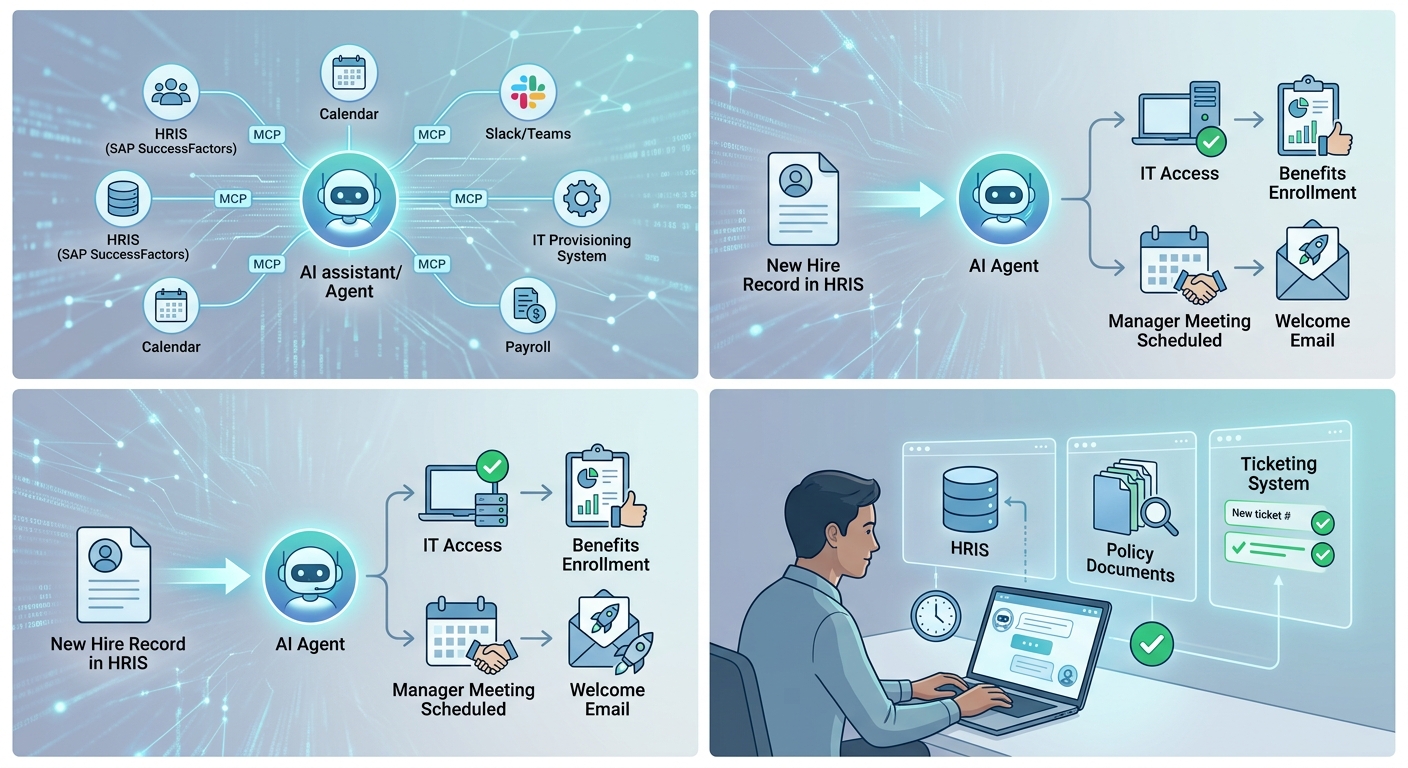
- Employee onboarding orchestration. A practical example: when a new hire record is created in SuccessFactors Employee Central, an MCP-connected AI agent can, in the same workflow, trigger IT account provisioning, kick off benefits enrollment tasks, and schedule a manager introduction meeting on the calendar — all through one protocol, rather than a separate integration for each downstream system.
- Leave and time-off request handling. Agents can check policy eligibility, validate balances, and notify managers automatically, reducing the back-and-forth that currently burdens HR operations.
- Payroll anomaly detection and compensation validation. MCP-connected agents can compare payroll run data against compensation records and flag discrepancies for human review before disbursement.
- Internal mobility and career development recommendations. By reading skills, performance, and role data across HRIS modules, agents can surface relevant internal openings or development paths to employees and managers.
- Automated compliance and audit reporting. Agents can pull structured data directly from HRIS systems — including role-based permission and access records — to assemble recurring compliance reports instead of relying on manual extracts.
- IT access provisioning and deprovisioning tied to joiner-mover-leaver events. When HRIS status changes, an agent can initiate the corresponding identity actions, closing the gap between HR events and IT access — a gap that has long been a top audit finding.
- HR service desk query resolution. AI agents connected via MCP to SuccessFactors, payroll, and knowledge-base systems can resolve common employee queries directly, escalating only genuinely complex cases to human HR staff.
Real Examples from SAP SuccessFactors and Other HCM Platforms
SAP has moved quickly on this front. At SAP TechEd 2025 in November, SAP made Model Context Protocol support for SAP HANA Cloud generally available, giving Joule and other agents direct, governed access to the underlying multi-model database engine. SAP Integration Suite has since added an MCP Gateway that exposes existing APIs and integration flows as MCP tools instead of rebuilding them from scratch. Then, at SAP Sapphire in May 2026, SAP and Anthropic announced a deeper strategic partnership bringing Claude into the new SAP Business AI Platform and Joule — enabling agents to close the books at quarter-end, answer complex employee leave questions, and reroute supplier orders mid-shipment, coordinating across S/4HANA, SuccessFactors, and Ariba. “The Autonomous Enterprise requires AI that understands business context and acts within the controls organizations depend on,” said SAP CEO Christian Klein. Separately, community and partner-built MCP servers already expose SuccessFactors OData APIs — employee records, role-based permissions, and configuration metadata — to AI agents, a pattern APAC integration teams are starting to build on for reporting and audit use cases.
Other HCM vendors are moving in parallel. In June 2026, Workday rolled out hundreds of MCP-based “Agent-Ready Tools” spanning HR, finance, and IT, letting external AI agents look up a record, update a benefit, or trigger an approval while inheriting Workday’s existing security, delegation, and audit controls — alongside its Illuminate agent suite covering areas like contingent hiring and contract intelligence. HR-native platform Darwinbox has gone further with “Super Agent,” launched in September 2025: an AI teammate anchored in HCM data that coordinates multi-system workflows across HR, IT, finance, and tools like Microsoft Teams and Slack — for instance, swapping an employee’s shift in the HR system while automatically notifying Facilities to grant temporary access. It illustrates where multi-system, MCP-style orchestration in HR is headed.
Benefits for HR and Integration Leaders
- Fewer manual errors, since data flows directly between systems rather than being re-keyed by hand.
- Faster cycle times for onboarding, leave approval, and access changes, because tasks that once required sequential human handoffs can run concurrently.
- Better employee experience, as routine queries and requests get resolved immediately rather than queued in a service desk backlog.
- More auditable AI actions, since MCP tool calls can be logged centrally, giving compliance teams a clearer trail than scattered email approvals.
Implementation Considerations
MCP is not a shortcut around integration governance — if anything, it raises the stakes on getting governance right.
- Security and role-based access. An MCP-connected agent should only see and act on what the authorizing user is permitted to — the underlying system’s permission model still applies. OWASP has published guidance specifically for secure MCP server development.
- Integration with existing SAP CPI, BTP, or iPaaS investments. Treat MCP as an additive layer, not a rip-and-replace — SAP’s own MCP Gateway wraps existing Integration Suite flows as MCP tools, so your prior integration work remains the foundation.
- Agent lifecycle governance. AI agents need the same joiner-mover-leaver discipline as employees: clear ownership, scoped permissions, and clean retirement when no longer needed.
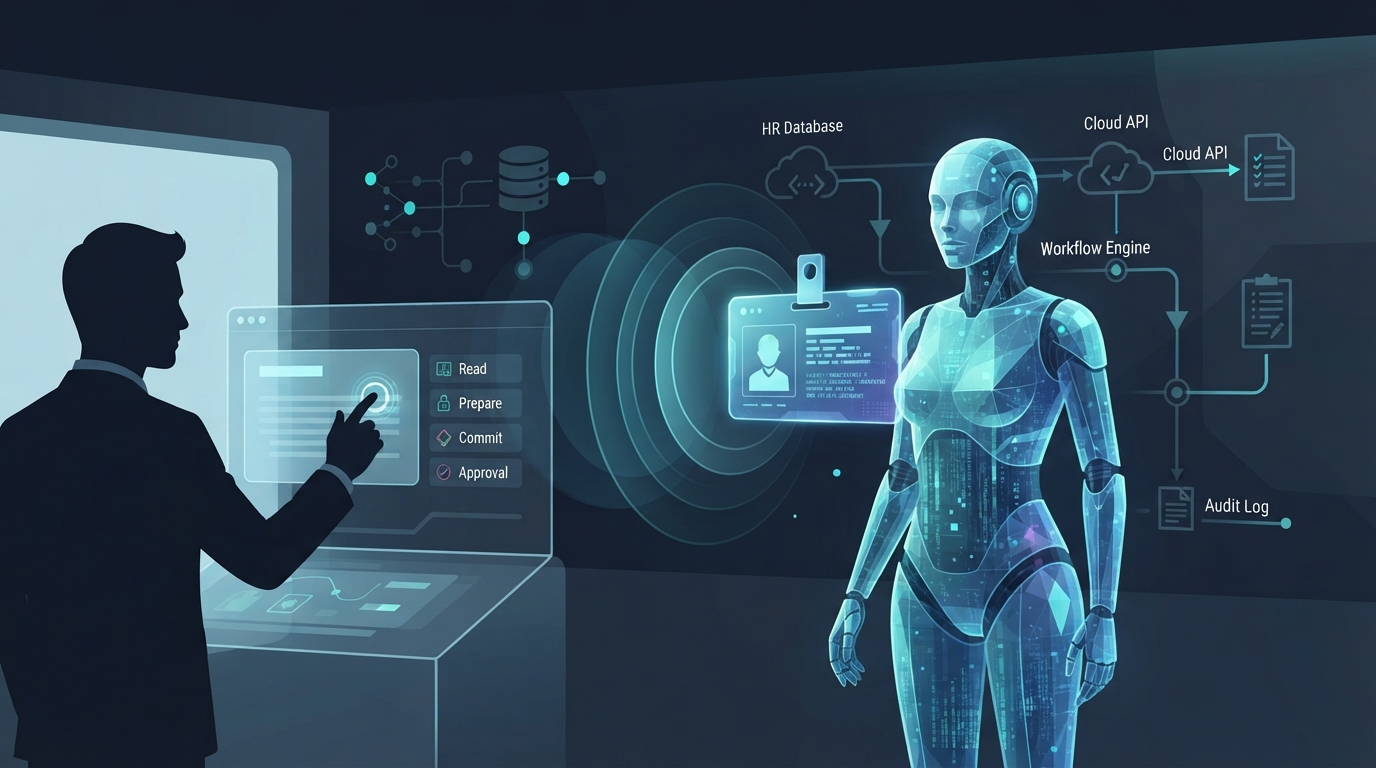
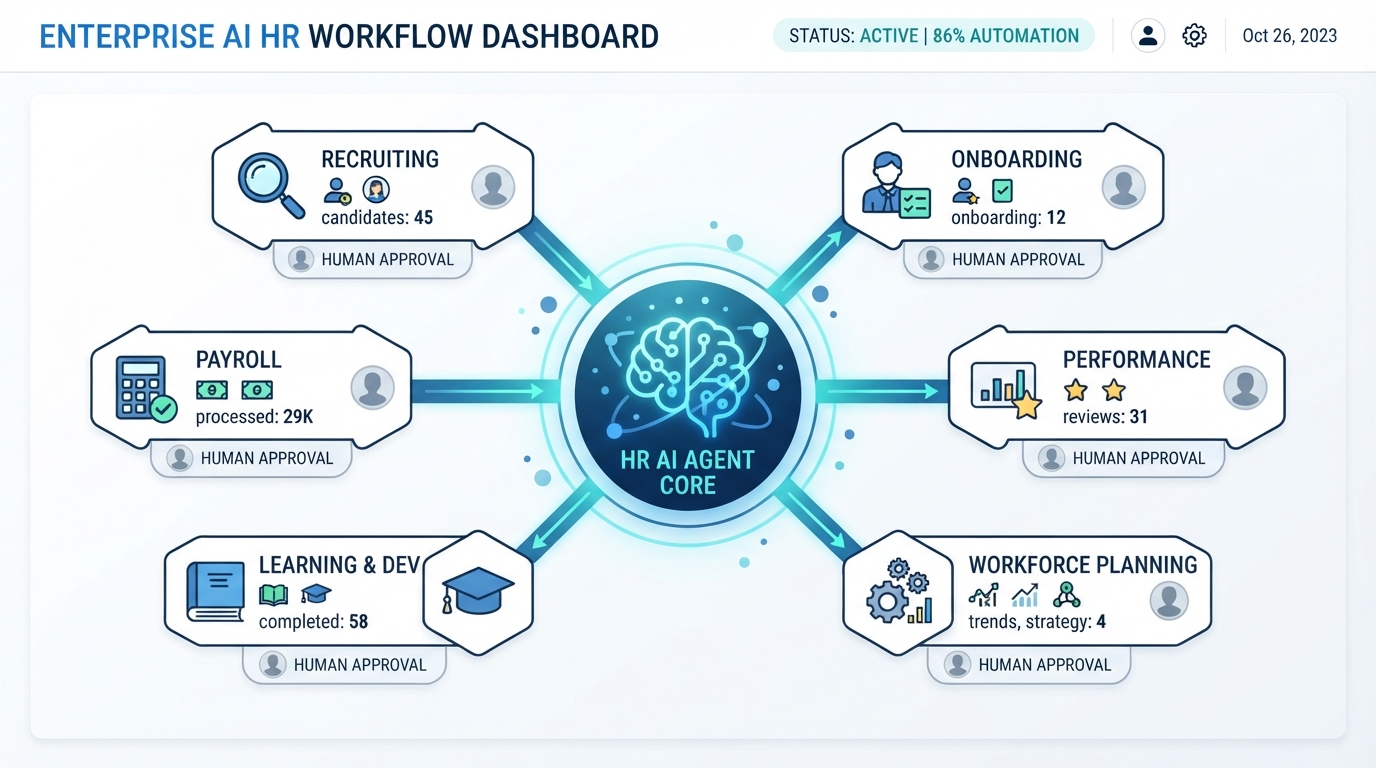
- Change management. Train teams on when agent-driven actions can proceed automatically and when human approval must stay in the loop — especially for payroll, terminations, or other compliance-sensitive changes.
What’s Next: Toward Autonomous HCM
The near-term roadmap for MCP includes technical upgrades — such as stateless transport variants — aimed squarely at higher-throughput enterprise use. More significantly, the orchestration layer sitting above MCP is where the real shift toward autonomy is happening: agents like Joule, Workday’s Illuminate suite, and Darwinbox’s Super Agent are starting to plan multi-step, cross-system HR workflows rather than executing single tasks in isolation. For APAC organizations running SAP SuccessFactors or S/4HANA, this points toward HCM environments where AI agents don’t just retrieve information but coordinate entire employee lifecycle events autonomously, with humans reviewing outcomes rather than performing every step.
Evaluate MCP-Based AI Agents Now
For HR leaders and integration architects across Malaysia and APAC, the practical next step isn’t a wholesale platform change — it’s auditing where repetitive HR tasks still consume the most manual effort, then piloting MCP-connected agents against one well-scoped workflow, such as onboarding or access provisioning. Organizations that start now will be best positioned as SAP, Workday, and the wider HCM ecosystem keep shipping MCP-native capabilities through 2026 and beyond.
Somewhere in your organization right now, an HR admin is re-typing a new hire’s details into a fourth system, or a departing employee’s access is still live three systems past their last day. That’s not a staffing problem — it’s an integration problem, and it’s exactly the gap MCP was built to close. The question for your next SAP or HCM roadmap review isn’t whether AI agents belong in your HRIS stack — it’s how much longer you can afford to run error-prone workflows by hand while competitors move to autonomous ones.