
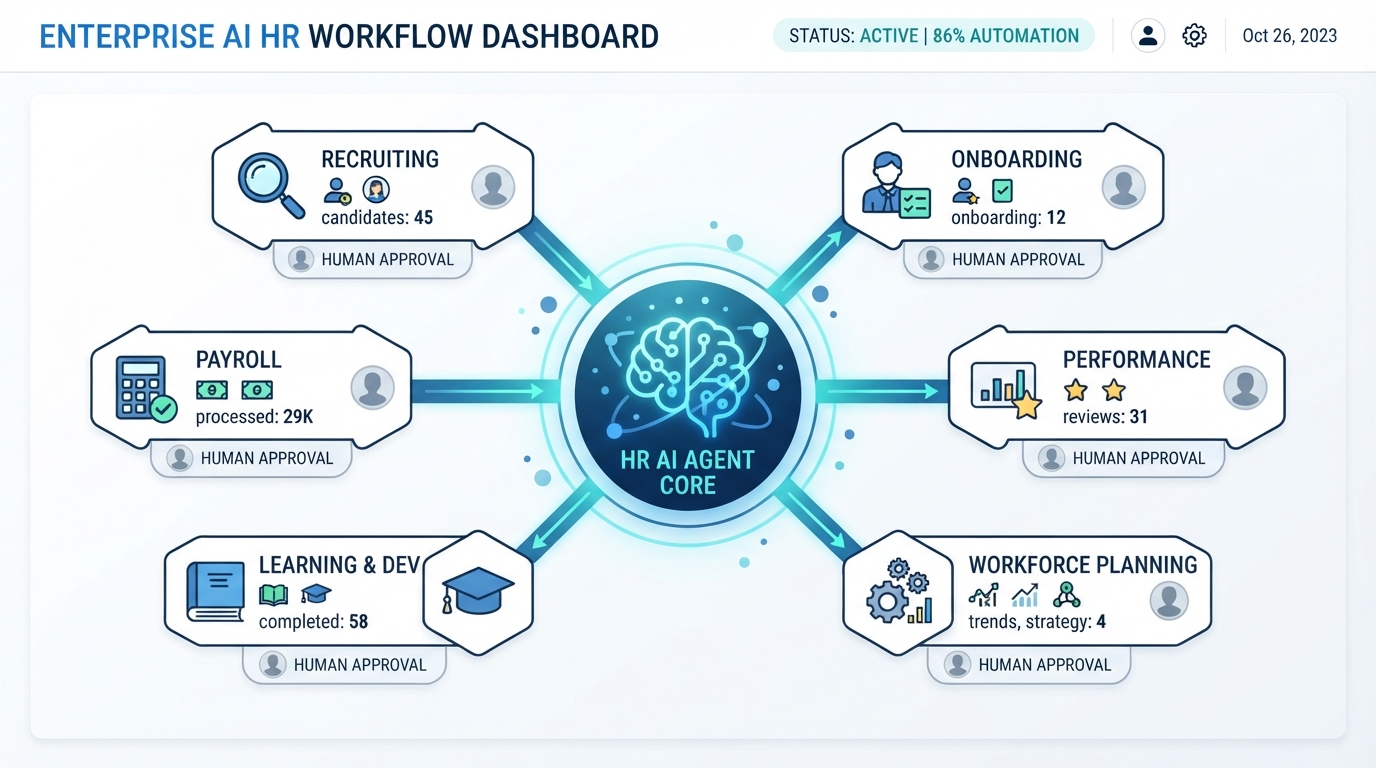
The landscape of HR technology is shifting dramatically in 2026. While 2025 saw organizations experimenting with isolated AI pilots, many HR leaders now recognise that real value lies in redesigning workflows around intelligent agents—moving beyond chatbots to autonomous systems that can plan, reason, and execute multi-step HR processes. This represents the emerging era of agentic HR in 2026, where AI is not simply layered onto existing processes but fundamentally reimagines how HR work flows. Understanding the rise of agentic AI in HR is essential for every HR leader, consultant, and integration architect navigating this shift.
This article covers what agentic HR means in practice, the real-world use cases running in production today, what AI agents in HR mean for SAP SuccessFactors teams, the governance risks you must address, and a practical eight-step roadmap for moving from pilot to production.
What Is Agentic HR in 2026?
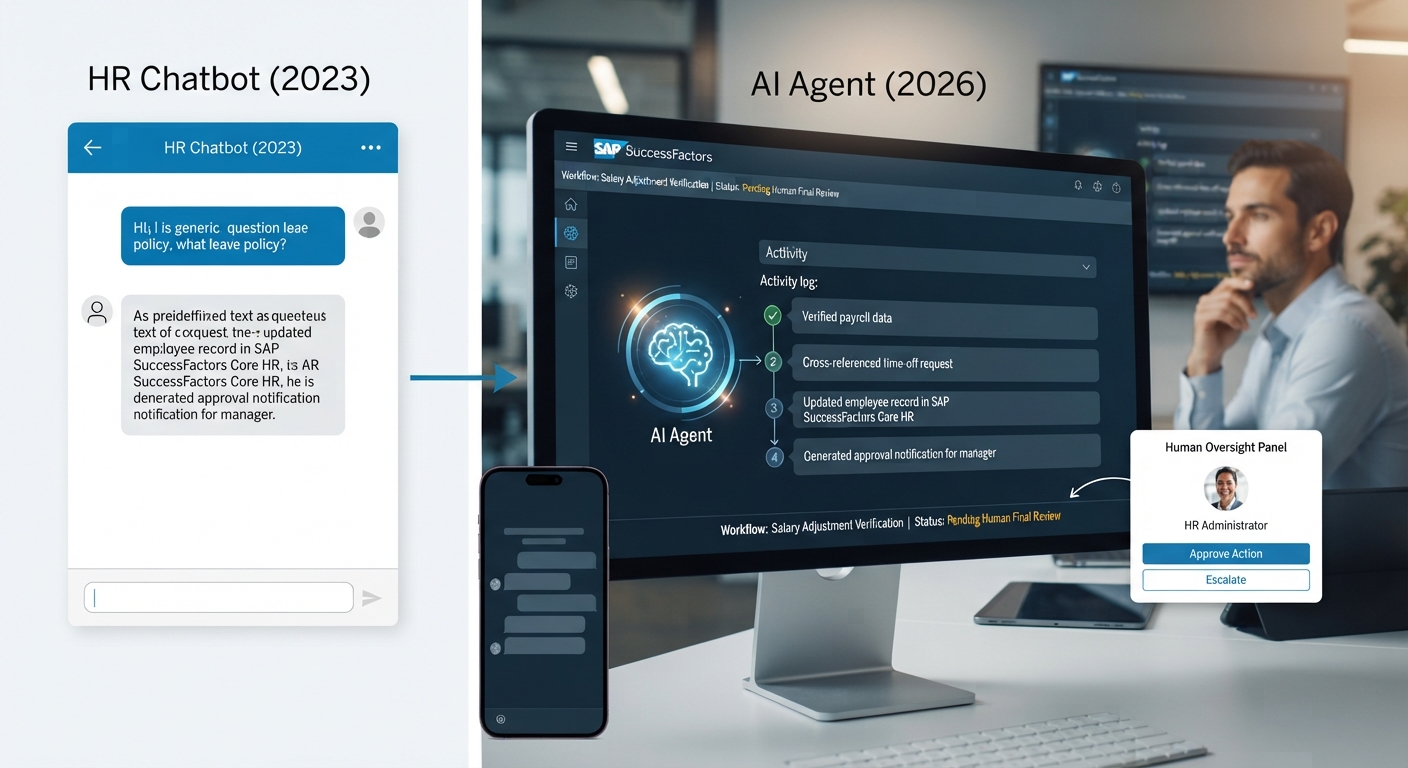
Agentic HR refers to intelligent systems that can autonomously plan, reason, and execute multi-step HR workflows. Unlike chatbots that answer questions or simple automation tools that follow predefined scripts, AI agents comprehend business context, adapt to variations, and handle complex decision-making with human oversight embedded at critical junctures. A growing body of work—including the guide on how MCP is transforming HRIS workflows in 2026—shows the underlying infrastructure that makes this level of autonomy possible.
Consider the distinction: a chatbot answers “How much PTO do I have?” An agentic system orchestrates the entire leave approval workflow—validating eligibility, checking team coverage, routing approvals, updating payroll systems, and notifying all relevant stakeholders. The agent understands dependencies, handles exceptions, and escalates edge cases to humans at the right moment.
In HR specifically, agentic systems reason across multiple data sources (Employee Central, payroll, org charts, policy documents); anticipate downstream consequences; adapt to edge cases without reprogramming; maintain full audit trails; and know when to escalate decisions to humans. This represents a qualitative shift from automation—”execute when X happens”—to agentic capability: “understand the goal, figure out how to achieve it, and adapt as conditions change.”
Why HR Is Moving from AI Pilots to Production Workflows
The “AI pilot trap” is real. Research consistently shows that a majority of HR AI initiatives remain stuck in pilots without measurable ROI—often because organisations treat pilots as proofs-of-concept rather than gateways to production scaling. A recurring root cause is why AI projects in HR are failing: fragmented systems and poor data foundations that prevent agents from functioning reliably at scale.
The broader challenge is AI-driven interconnectivity across HR tech—siloed data across payroll, HRIS, and talent platforms creates the fragmentation that undermines agentic workflows before they even start. Yet leading enterprises including Atlassian, Moderna, UKG, and Lumen are now deploying agentic HR workflows in production at scale, demonstrating that the path from pilot to production is achievable with the right foundations in place.
Three forces are driving the shift. First, cost pressure and headcount constraints force HR to redesign workflows rather than simply add resources. McKinsey research estimates that generative AI could automate up to 40% of HR administrative tasks, creating significant capacity for strategic work. Second, employees now expect self-service and instant answers—waiting days for an HR response to a policy question is no longer acceptable when AI agents can resolve 80% of cases in under two minutes. Third, and most critically, leading CHROs are reframing AI not as a tool to automate existing processes but as a catalyst to reimagine work itself. The deeper context—how digital transformation in HR is reshaping the entire function—underscores that agentic workflows are the next chapter in a longer transformation journey.
Agentic HR Use Cases in Production Today
Here are seven concrete use cases running in production at leading enterprises, each with measurable outcomes:
1. HR Service & Employee Support
Agents handle high-volume, repetitive enquiries—health insurance deductibles, parental leave policy, 401(k) deferral rules—by retrieving answers from policy documents and employee records, providing context-aware guidance, and escalating complex issues to HR specialists. Reported metrics: 75% case deflection rate, average handle time under two minutes, employee satisfaction at 4.5 out of 5.
2. Recruiting and Talent Acquisition
Agents screen résumés against job descriptions, schedule interviews, draft candidate outreach, and send rejection notifications—learning from recruiter feedback to improve accuracy over time. One Fortune 500 technology company reduced time-to-first-interview from eight days to two days and improved offer acceptance rates by 12% using agentic screening.
3. Onboarding Coordination
Agents orchestrate multi-party onboarding: collecting required documents, provisioning system access, scheduling orientation sessions, and coordinating between IT, payroll, and facilities. They proactively notify new hires of next steps and escalate blockers in real time. Impact: 40% reduction in onboarding cycle time and significantly fewer cases of missing or delayed new-hire documentation.
4. Learning & Development Recommendations
Agents assess employee skills, recommend personalised learning paths aligned to role, career goals, and market trends, and coordinate microlearning delivery. They track completion and adapt recommendations dynamically. Outcome: 35% increase in training completion rates and measurably better alignment between L&D investment and business capability needs.
5. Performance and Goals Support
Agents help managers draft performance review inputs by summarising employee accomplishments, tracking goal progress against original objectives, and flagging achievements and gaps. They reduce the cognitive load on managers during review cycles while improving consistency. Impact: 25% faster performance cycle close and more consistent feedback quality across the organisation.
6. Payroll Explanation & Variance Support
Agents explain pay slip details, overtime calculations, deduction variances, and benefit cost changes—without modifying payroll data. This boundary is non-negotiable: agents inform, not transact. Organisations using payroll explanation agents report 40% reductions in payroll team enquiry volume, freeing specialists for complex exception handling.
7. Workforce Planning & People Analytics
Agents answer natural-language questions about headcount, tenure distribution, skills gaps, and turnover trends—and run scenario analyses (“What does hiring 20 engineers in Q2 do to our span-of-control ratios?”). For CHROs building a structured approach, the workforce planning framework CHROs need in 2026 provides a rigorous foundation before deploying AI agents in this domain. One mid-size SaaS company reduced its planning cycle from six weeks to two weeks using natural-language workforce analytics.
Agentic HR in SAP SuccessFactors: What Is Real in 2026?
SAP’s agentic HR roadmap is moving fast. For a full breakdown of announced capabilities, the dedicated guide on AI agents in HR and SAP SuccessFactors covers every announced agent in detail. Here we focus on implementation realities.
SAP’s Joule-powered agents include: the Performance and Goals Agent (GA November 2025), enabling natural-language review drafting and goal tracking; and planned agents for Career Development, HR Service, Payroll, and People Intelligence targeting 1H 2026, with broader “Autonomous HCM” positioning for later in 2026.
Critical caveat for buyers: Independent reviews found that several 1H 2026 agent announcements lacked clear GA or beta labelling at time of writing. Request written confirmation from SAP on production-readiness status before committing to implementation timelines or licensing decisions.
Before going to production, SuccessFactors teams must validate five areas:
- Licence and Entitlement: Confirm whether agentic capabilities are included in your current edition or require a separate purchase. SAP’s packaging continues to evolve and varies by contract.
- Role-Based Permissions and Data Access: Agents inherit Employee Central permission structures. Audit comprehensively—especially around compensation, performance ratings, and disciplinary records.
- Data Quality in Employee Central: Incomplete org charts, missing job descriptors, or stale position data produce unreliable agent outputs. Fix data before deploying agents, not after.
- Integration Dependencies: Most agent use cases require orchestration across S/4HANA, CPI/Integration Suite, ITSM platforms, and identity management. Your AI-ready HR integration architecture for SuccessFactors and S/4HANA must be solid before agents go live.
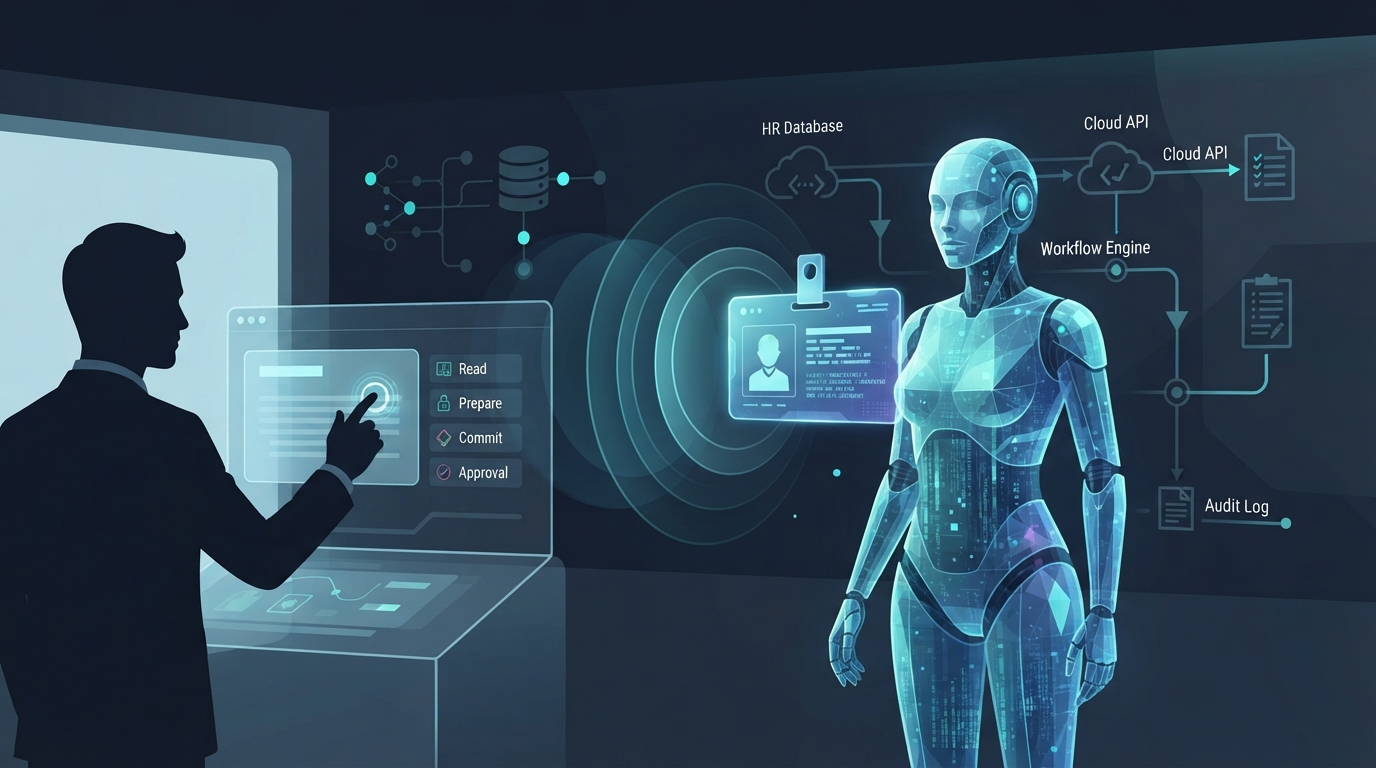
- Human Approval Points and Audit Logs: Define which decisions are fully automated versus which require explicit human approval. Maintain immutable, queryable audit logs of every agent action and the reasoning behind it.
Risks and Guardrails for Agentic HR
Agentic HR carries risks that must be managed systematically, not addressed as an afterthought. SHRM research highlights that 68% of HR leaders view AI governance and transparency as their top concern when deploying AI in talent management. For a deep technical view on the security dimension, how AI agents securely interact with enterprise systems is essential reading for every integration architect working on agent deployments.
Sensitive Data Exposure: HR agents access compensation data, medical history, disciplinary records, and performance ratings. Implement zero-trust access controls and mask sensitive fields by default. A misconfigured agent that inadvertently exposes salary data across an organisation creates immediate legal and reputational liability.
Hallucination and Inaccuracy: AI agents can provide incorrect guidance on policy, benefits eligibility, or legal requirements with apparent confidence. An agent that misstates leave eligibility or gives incorrect compliance advice creates regulatory exposure. Human verification loops are mandatory for any output that affects an employee’s rights or entitlements.
Bias and Discrimination: In recruiting, performance, and succession contexts, agentic systems can perpetuate or amplify historical bias if trained on skewed data. The EU AI Act classifies employment AI as high-risk; many jurisdictions require documented bias audits before deployment. EEOC guidance confirms employers remain liable for discriminatory AI-driven decisions. The broader landscape of AI in HR transformation—its opportunities and risks—covers the regulatory landscape in detail.
Excessive Autonomy and Automation Bias: Agents with poorly defined boundaries make unintended decisions—rejecting candidates on incomplete data, approving requests that violate policy. Automation bias is equally dangerous: humans rubber-stamping AI outputs without scrutiny. Both require active governance design, not passive monitoring.
What Good Governance Looks Like
Effective governance assigns clear ownership across HR (workflow owner), IT (system owner), Legal (compliance), and Privacy (data protection). Every agentic use case is risk-classified: informational workflows such as policy Q&A are low-risk; decisional workflows affecting compensation, hiring, or employment status are high-risk and require mandatory human gates. Every agent action is logged with its reasoning so recommendations can be explained and challenged. Performance monitoring—accuracy, bias metrics, user satisfaction—runs continuously, with agents retrained when metrics drift.
A Practical Roadmap: From Pilot to Production Agentic HR
Step 1: Inventory and Prioritise Workflows. List all HR workflows and identify agent-ready candidates: high-volume, rule-based, low-risk (leave requests, policy Q&A, interview scheduling). Start here—never with complex judgment calls or high-stakes decisions.
Step 2: Classify by Risk. Map each workflow to a risk tier. Q&A workflows are low-risk. Recruiting screening is medium-risk. Compensation changes, terminations, and succession decisions are high-risk under frameworks including the EU AI Act. Governance effort should be proportional to risk.
Step 3: Fix Data and Permissions Foundations. Audit Employee Central data quality. Verify org structures are current. Validate role-based access control configurations. Ensure your integration architecture for AI in HR supports the agent’s data and system access requirements. Data quality failures are the leading cause of agentic workflow failures in production.
Step 4: Design the Human-in-the-Loop Model. Define explicitly what agents auto-execute versus what requires human approval. Document escalation criteria. Example: “Agents screen résumés and categorise candidates. Recruiters make all shortlisting decisions.” The boundary must be written, communicated, and enforced technically.
Step 5: Define Success Metrics Before You Start. Examples: 70% case deflection for HR Q&A, 50% reduction in time-to-hire, 4.0+ employee satisfaction for onboarding, demonstrated ROI within 90 days. Align metrics with business outcomes—not AI activity metrics like “queries processed.”
Step 6: Run a Bounded Pilot. Deploy to one workflow and one pilot group (50 employees or one department) for 4–6 weeks. Collect quantitative and qualitative data. Expect 2–3 iterations before reliable performance—this is normal engineering, not failure.
Step 7: Measure, Learn, and Adjust. Compare results to baseline. If targets are met, proceed. If not, diagnose the failure mode: hallucination, low user trust, poor escalation design, or data quality issues. Fix the root cause before expanding scope.
Step 8: Scale Gradually to Adjacent Workflows. Expand systematically. Build a governance rhythm: monthly agent health reviews, quarterly bias audits, annual AI strategy updates. Governance is not a one-time configuration—it is a continuous operational discipline.
The Future of Agentic HR Beyond 2026
By 2027–2028, expect agents that orchestrate end-to-end workflows spanning HR, IT, Finance, and Procurement—where a single onboarding agent handles background checks, system provisioning, expense card setup, and policy onboarding across all enterprise systems simultaneously. SAP’s Autonomous HCM vision points toward native reasoning across SuccessFactors, S/4HANA, and collaboration platforms.
Regulatory pressure will intensify. EU AI Act enforcement mechanisms are activating through 2026, with analogous frameworks emerging across Asia and the Americas. Organisations that embedded compliance-by-design into their agentic architecture will be well positioned; those that treated governance as an afterthought will face costly retrofits and penalties.
Most importantly, HR’s organisational identity is evolving. The question is shifting from “How do we automate this workflow?” to “How should this workflow be fundamentally redesigned now that AI can handle complexity at scale?” HR leaders who master this distinction will build lasting competitive advantage—not just in operational efficiency, but in their organisation’s ability to attract, develop, and retain talent in an AI-native economy.
Conclusion
Agentic HR in 2026 is a genuine inflection point. The move from isolated AI pilots to integrated, measurable production workflows is underway in leading enterprises—and the gap between organisations scaling and those still piloting is growing. Success depends not on the sophistication of the AI but on the quality of your data, the clarity of your governance, and the intentionality of your human oversight design.
For SAP SuccessFactors implementation teams, consultants, and HR leaders: start with a detailed overview of AI agents in HR to ground your strategy, ensure your data and system foundations are solid with the right AI-ready HR integration architecture for SuccessFactors and S/4HANA, and pilot with clear metrics and governance from day one. The future of HR work is agentic. The question is whether your organisation will lead or follow.

One thought on “Agentic HR in 2026: From AI Pilots to Production Workflows in SAP SuccessFactors and Beyond”