
Artificial Intelligence is everywhere in HR right now.
From AI-powered recruiting and employee sentiment analysis to workforce planning and predictive payroll analytics, organizations are investing heavily in HR transformation initiatives.
But many companies are discovering something unexpected:
The biggest obstacle to AI adoption is not the AI itself.
It is fragmented HR systems.
The Real Problem Nobody Talks About
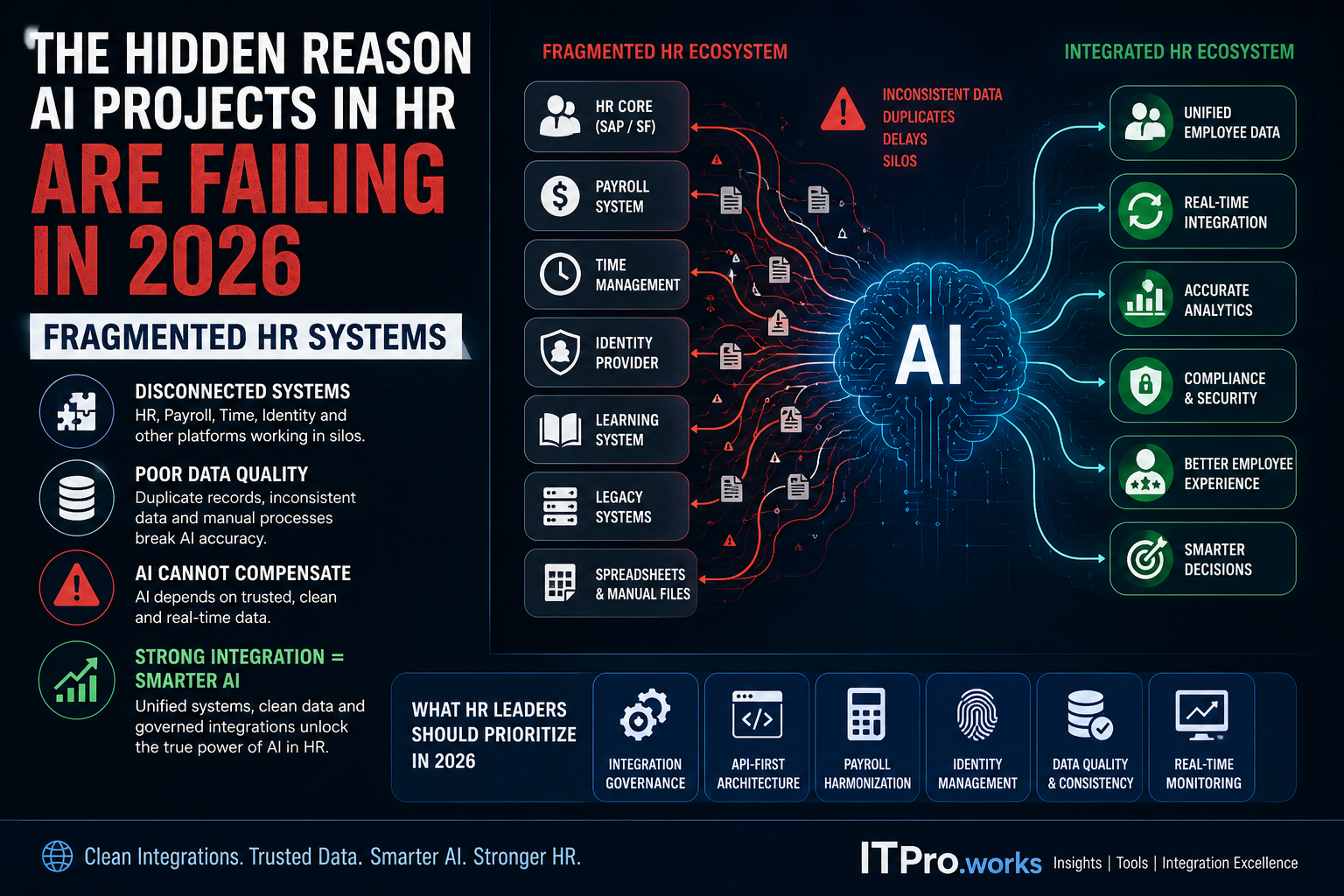
Most enterprises operate with disconnected HR ecosystems:
- HR Core systems
- Payroll vendors
- Identity providers
- Learning systems
- Time management platforms
- Legacy finance integrations
- Regional middleware solutions
- Manual spreadsheets
On paper, these systems appear connected.
In reality, many organizations still rely on:
- duplicate employee data,
- manual reconciliation,
- delayed integrations,
- inconsistent APIs,
- and fragmented reporting structures.
This creates a major issue for AI-driven HR operations.
AI depends on trusted, connected, real-time data.
Without clean integration foundations, AI becomes unreliable.
SAP recently highlighted that fragmented HR, payroll, and time systems are becoming one of the largest barriers to realizing the full value of AI in HR operations.
Why Fragmentation Breaks AI
AI systems are only as effective as the data they receive.
If:
- employee records are inconsistent,
- payroll data arrives late,
- APIs fail silently,
- or organizational structures differ across systems,
then AI recommendations become inaccurate.
This impacts:
- workforce planning,
- employee experience,
- compliance,
- payroll validation,
- hiring intelligence,
- and executive reporting.
Organizations attempting to “add AI on top” of broken integration landscapes often create more operational risk instead of reducing it.
According to recent HR trend research, AI is rapidly becoming central to workforce decision-making, but organizations continue to struggle with governance, trust, interoperability, and adoption challenges.
The Payroll Problem
Payroll remains one of the highest-risk areas in enterprise HR transformation.
Disconnected payroll ecosystems commonly introduce:
- delayed employee synchronization,
- duplicate records,
- failed retro calculations,
- incorrect tax handling,
- inconsistent employee identifiers,
- and integration bottlenecks.
SAP research reported that organizations operating with unified HR foundations significantly reduced payroll errors and accelerated payroll processing cycles.
The message is becoming clear:
AI cannot compensate for broken integrations.
Integration Teams Are Becoming Strategic
For years, integration work was treated as a technical backend function.
That is changing quickly.
Modern integration architects now directly influence:
- workforce analytics,
- AI readiness,
- employee experience,
- compliance,
- cybersecurity,
- and operational resilience.
Middleware platforms such as:
- SAP CPI,
- MuleSoft,
- Dell Boomi,
- and enterprise API management platforms
are no longer just “connectors.”
They are becoming the foundation of enterprise intelligence.
The Rise of AI-Aware HR Architecture
Organizations moving successfully into AI-enabled HR operations are focusing on:
1. Unified Employee Master Data
Consistent employee identifiers across systems.
2. API-First Architectures
Replacing file-based manual processes with governed APIs.
3. Real-Time Integration Monitoring
Visibility into integration failures before business impact occurs.
4. Secure Identity Synchronization
Modern OAuth2, SSO, and identity governance models.
5. Clean Payroll Integration Layers
Reducing dependency on manual reconciliation.
6. Standardized Middleware Governance
Avoiding uncontrolled integration sprawl.
AI Will Expose Weak Architecture Faster Than Ever
Historically, fragmented integrations could remain hidden for years.
AI changes that.
AI amplifies:
- data quality problems,
- process inconsistencies,
- governance gaps,
- and integration failures.
Organizations with mature integration foundations will accelerate faster.
Organizations with fragmented ecosystems may struggle with:
- inaccurate AI outputs,
- compliance risks,
- trust issues,
- and failed transformation programs.
What HR Leaders Should Prioritize in 2026
Instead of chasing every new AI feature, organizations should first focus on:
- integration governance,
- middleware modernization,
- payroll harmonization,
- API standardization,
- identity management,
- and enterprise data consistency.
The future of AI in HR is not just about smarter algorithms.
It is about cleaner architecture.
Final Thoughts
The organizations that succeed with AI in HR will not necessarily be the ones with the most AI tools.
They will be the ones with:
- the cleanest integrations,
- the most trusted employee data,
- the strongest middleware governance,
- and the most scalable HR architecture.
AI is becoming the spotlight that exposes weaknesses already present in enterprise ecosystems.
The question is no longer:
“Should we adopt AI in HR?”
The real question is:
“Is our HR integration architecture ready for AI?”

One thought on “The Hidden Reason AI Projects in HR Are Failing in 2026 — Fragmented HR Systems”