
Introduction
For decades, workforce planning operated in isolation from strategy. HR teams counted headcount, planned roles, and forecasted staffing needs independent of broader business objectives. The result: organizations simultaneously over-staffed in some areas while facing critical talent shortages in others.
In 2026, this approach is no longer viable.
As artificial intelligence reshapes work faster than organizations can adapt, and as CEOs demand visibility into how workforce decisions impact strategic execution, CHROs face a fundamental imperative: shift from planning for people to planning for work.
The central premise is simple but transformative: Organizations cannot forecast the workforce until they forecast the work.
This insight, documented in Gartner’s “A New Enterprise Strategic Workforce Planning Imperative for CHROs,” represents a fundamental shift in how enterprise leaders should approach workforce strategy. Rather than starting with job titles and headcount, organizations must begin with the actual work that drives business strategy, quantify how that work will be delivered (through humans, AI, or hybrid approaches), and only then determine workforce requirements.
The stakes are substantial. Gartner research shows that organizations with effective workforce planning are 1.4x more likely to exceed revenue goals and 1.5x more likely to exceed cost targets. Yet only 26% of CHROs believe they have the talent and technology needed to execute their business strategy—a confidence gap that directly reflects the absence of rigorous workforce planning frameworks.
The Problem: Why Traditional Workforce Planning Fails
The Definition Crisis
Ask five CHROs to define “strategic workforce planning” and you’ll likely receive five different answers. One views it as headcount management. Another sees it as skills inventory planning. A third frames it as succession management. A fourth focuses on organizational design.
While each of these contributes value, none independently translates enterprise strategy into workforce requirements. This fragmentation is not accidental—it reflects a deeper structural problem: traditional workforce planning lacks a common definition and integrating framework.
The consequence is predictable: organizations struggle to quantify future workforce demand, assess capability risks, and evaluate the workforce implications of AI investments before critical decisions are made. Strategic workforce planning remains an HR exercise disconnected from finance, strategy, operations, and technology decisions.
Historical Staffing Patterns Are Obsolete
Traditional workforce planning relies on historical staffing ratios. If your organization currently has 1 architect per 8 engineers, the assumption is that ratio will hold relatively constant as you scale.
This assumption was reasonable when work was stable and predictable. But as AI reshapes which tasks humans perform, historical staffing patterns become unreliable guides. An organization that has used automation to eliminate 30% of transactional accounting work cannot reliably forecast future accounting headcount by extrapolating from historical head-to-transaction ratios. The work distribution has fundamentally changed.
Gartner data reinforces this risk: By 2029, 30% of employees who were terminated and replaced by AI will be rehired—often at 30% higher cost—due to ineffective workforce planning strategies. This costly cycle of separation and rehiring reflects organizations making staffing decisions before understanding how work will actually be performed.
The Financial Cost of Poor Planning
The financial impact of misaligned workforce planning is substantial. In a 60,000-employee organization, a 2% workforce reduction followed by rehiring 30% of affected employees can cost nearly $100 million. This cost includes severance, recruitment, onboarding, productivity ramp-up, and the institutional knowledge lost in departures.
This expensive cycle is avoidable with better planning. When organizations understand the work required to execute strategy and how that work will be distributed across humans and AI, they avoid costly workforce adjustments and position themselves to align talent investments with strategic priorities.
The Solution: Gartner’s Enterprise Strategic Workforce Planning Framework
Gartner’s Enterprise Strategic Workforce Planning Framework represents a fundamental rethinking of how workforce planning should operate. Rather than an HR-centric process, it positions workforce planning as an enterprise discipline that connects strategy, finance, technology, operations, and human resources decisions.
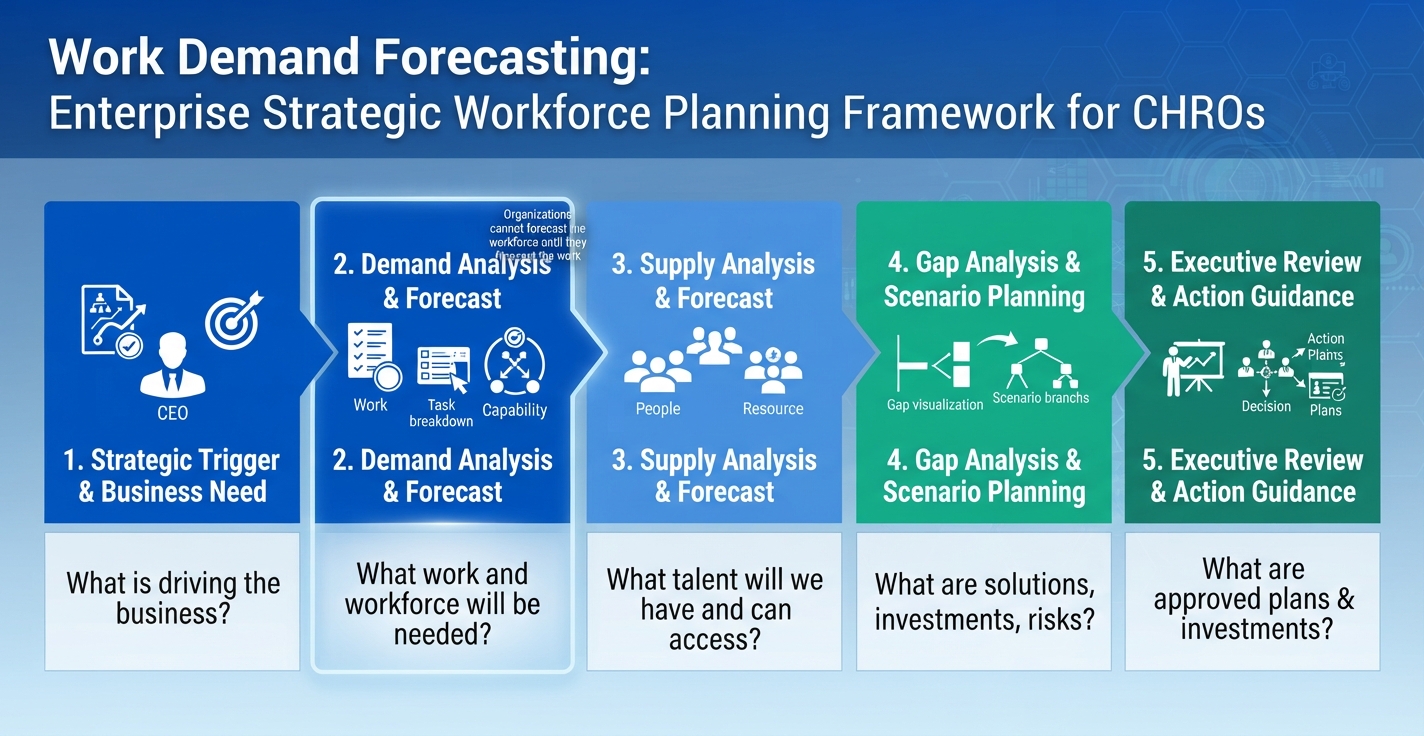
The framework consists of five integrated phases:
Phase 1: Strategic Trigger and Business Need
Question: What is driving the business?
This phase anchors workforce planning to enterprise strategy rather than HR assumptions. The CHRO, CFO, CIO, COO, and CEO align on strategic priorities, financial plans, and technology/AI roadmaps. Rather than HR creating a workforce plan in isolation, the entire leadership team confirms what business outcomes matter most.
Example: An organization may decide to expand into three new geographic markets. This strategic trigger cascades into subsequent phases: What capabilities are required? What work must be performed? How many people—or AI agents—will perform it?
Phase 2: Demand Analysis and Forecast
Question: What work and workforce will be needed?
This is where the framework differs most from traditional planning. Rather than starting with role inventories or current headcount, demand analysis begins by identifying the capabilities required to execute strategy, then quantifies the actual work needed to deliver those capabilities.
The process unfolds in sequence:
- Identify capabilities required to execute the strategic priority
- Quantify work volume based on demand drivers (customer growth, transaction volume, service scope)
- Allocate work distribution between human performance, AI automation, and hybrid approaches
- Translate remaining human work into workforce requirements by role, skill, and location
Example from the Gartner paper: An organization launching a new digital service may forecast customer growth, identify required capabilities (platform engineering, data governance, customer support), quantify supporting work (design, integration, testing, deployment), assess AI-enabled execution, and determine workforce implications before capability gaps emerge.
This quantified approach replaces qualitative estimation (“We’ll probably need more analysts”). Instead, workforce decisions are grounded in actual work demand.
Phase 3: Supply Analysis and Forecast
Question: What talent will we have and can access?
Supply analysis projects the future availability of workforce talent. This phase assesses:
- Current talent by role, skill, and capability
- Internal labor market conditions (career paths, mobility, retention)
- External labor market conditions (talent availability, competitive recruiting, skill scarcity)
- Attrition trends and ramp-to-productivity curves
- Skills overlap and transferability
The goal is to create a realistic view of what talent will be available to meet forecasted demand.
Phase 4: Gap Analysis and Scenario Planning
Question: What are the recommended solutions, investments, and risks?
Gap analysis compares forecasted demand with available supply, identifying shortfalls and surpluses by capability. Rather than producing a single plan, organizations should develop multiple scenarios:
- Base case: Expected business conditions
- Upside scenario: Accelerated growth or market opportunity
- Downside scenario: Market contraction or resource constraints
For each scenario, the organization models the workforce implications, quantifies gap-closing costs, assesses risks, and identifies decision thresholds.
Phase 5: Executive Review and Action Guidance
Question: What are the approved plans, investments, and governance?
Final decisions cascade to operations, talent acquisition, learning, finance, and technology functions. Workforce decisions are no longer isolated—they’re integrated with business strategy, financial planning, and AI investment decisions.
This phase also establishes governance: Who owns workforce planning decisions? How are trade-offs between hiring, automation, and reskilling evaluated? How frequently is the plan refreshed as market conditions change?
The Critical Insight: Quantifying Work Demand Before Workforce Demand
The framework’s distinguishing feature—and the capability that Gartner identifies as most differentiating—is the emphasis on quantifying work demand before forecasting workforce demand.
Organizations cannot forecast the workforce until they forecast the work.
This principle has profound implications. Traditional workforce planning flows like this:
Strategy → Assess current headcount → Make headcount adjustments → Update hiring plans
The framework proposes a fundamentally different flow:
Strategy → Identify required capabilities → Quantify required work → Distribute work across human/AI/hybrid → Calculate workforce demand → Assess supply vs. demand → Recommend actions
The difference is material. By starting with work rather than people, organizations gain several advantages:
- Earlier visibility into capability risks – If customer growth is projected to increase 50% but the capability to deliver that growth is only 60% clear, the organization identifies the gap early
- More informed AI investment decisions – Rather than automating tasks reactively, the organization understands which work should be human, which AI, and which hybrid based on strategic value
- Stronger financial discipline – Workforce investments are tied to quantified work demand, not historical ratios
- Greater organizational agility – As market conditions change, the work demand forecast updates first, enabling faster workforce adjustments
What This Means for CHROs
This shift carries significant leadership implications for the CHRO role.
Traditionally, CHROs respond to workforce questions after strategic decisions have been made. A CEO announces a market expansion; the CHRO estimates headcount needs and presents a hiring plan. A CIO commits to a digital transformation; the CHRO forecasts skills gaps and training needs.
The Enterprise Strategic Workforce Planning Framework inverts this dynamic. CHROs who master this framework become enterprise planning partners—they help shape strategic decisions by quantifying workforce implications before those decisions are finalized.
When the board considers a major AI investment, the CHRO equipped with work demand forecasting can provide the board with precise answers:
- How many roles will be affected?
- Which roles will be automated? Which will be augmented?
- What new capabilities will emerge?
- What is the total cost of workforce transition?
- What is the timeline for capability building?
- What risks could jeopardize execution?
This transforms the CHRO from a tactical function (“Here’s how many people we need to hire”) into a strategic advisor (“Here’s what the strategic plan means for workforce risk, capability investment, and financial outcomes”).
Gartner reinforces this evolution: “The goal of enterprise strategic workforce planning is not to produce a workforce plan but to provide leadership with the workforce intelligence needed to make better enterprise decisions.”
Key Statistics: The Business Case for Better Workforce Planning
Gartner’s research provides compelling evidence for investing in enterprise workforce planning capabilities:
Financial Performance:
- Organizations with effective workforce planning are 1.4x more likely to exceed revenue goals
- Organizations with effective workforce planning are 1.5x more likely to exceed cost targets
The Cost of Poor Planning:
- In a 60,000-employee organization, a 2% workforce reduction followed by rehiring 30% of affected employees can cost nearly $100 million
- By 2029, 30% of employees terminated and replaced by AI will be rehired, often at 30% higher cost, due to ineffective workforce planning strategies
Current Capability Gaps:
- Only 26% of CHROs believe they have the talent and technology they need to execute their business strategy
- This confidence gap reflects both the absence of planning frameworks and the tools/skills needed to implement them
Implementation Priorities: Getting Started
For CHROs considering adoption of enterprise strategic workforce planning, Gartner recommends prioritizing three foundational steps:
1. Define Workforce Planning for Your Organization
Create a common definition across leadership that aligns with the strategic context. Rather than viewing workforce planning as HR headcount management, position it as an enterprise planning discipline that translates strategy into workforce implications.
2. Establish Cross-Functional Governance
Workforce planning cannot succeed within HR alone. Establish a governance structure that brings together strategy, finance, technology, operations, and HR leadership. Quarterly or monthly alignment meetings ensure workforce decisions remain synchronized with business planning cycles.
3. Start with Work, Not People
Begin with your most critical business capability. Define the work required, quantify volume, assess AI/automation potential, and calculate workforce implications. Use this first capability as a proof-of-concept to validate the framework and build organizational capability for scaling.
Looking Ahead: Enterprise Workforce Planning as Competitive Advantage
As AI reshapes work faster than organizations can adapt, and as CEOs and boards demand more precise visibility into workforce implications of strategic decisions, enterprise strategic workforce planning will become table stakes for competitive organizations.
The organizations that win will be those that develop rigorous capability for quantifying and forecasting work demand. They will make faster, more confident workforce decisions. They will avoid costly workforce mistakes. They will position talent where it creates strategic value.
For CHROs, the opportunity extends beyond process improvement. The opportunity is to become the executive who can quantify the people implications of enterprise strategy before critical business decisions are finalized.
Key Takeaways
✅ Work demand forecasting, not headcount planning, should drive workforce decisions
✅ Organizations cannot forecast the workforce until they forecast the work
✅ Historical staffing patterns are unreliable guides in an AI-driven economy
✅ The Enterprise Strategic Workforce Planning Framework integrates strategy, finance, technology, operations, and HR decisions
✅ CHROs who master this framework become enterprise planning partners, not just HR stewards
✅ Effective workforce planning delivers 1.4x revenue upside and 1.5x cost discipline
Further Reading & Resources
For CHRO Leaders:
- SAP SuccessFactors Workforce Planning Integration – Technical approaches to workforce data integration
- Enterprise HR Data Architecture – Data foundations for workforce analytics
- AI Governance in HR Systems – Governance frameworks for AI-driven HR decisions