It is Monday morning, and an HR business partner has three AI tools open. One drafts job descriptions, another summarises policy documents, and a third answers employee questions. Yet she still spends most of the day chasing a hiring-manager approval, reconciling headcount figures between two systems, and working out who signed off on a contract extension. The tools are capable. The work around them has not changed. That gap is where the human-agent workforce either succeeds or stalls.
AI agents can now plan and complete multi-step tasks, not just answer prompts. However, adding an agent to a broken process mostly speeds up the confusion. The organisations that benefit are redesigning workflows so that people define goals, set constraints, review outputs, and remain accountable, while agents take on well-bounded pieces of the work.
This article explains how leaders in HR, IT, architecture, security, and operations can approach that redesign in 2026 without treating AI as a simple headcount-reduction exercise.
In this article
- From AI tools to human-agent teams
- Why workflow design matters more than the model
- What humans must continue to own
- Skills for the human-agent workforce
- Enterprise foundations: data, integration, identity and governance
- A practical five-step operating model
- What leaders should do next
- Conclusion
From AI Tools to Human-Agent Teams
In plain terms, an AI agent is software that can take a goal, break it into steps, use connected tools or data to act on those steps, and report back. That is different from a chatbot that only answers questions, or a rules-based automation that follows the same fixed path every time.
Microsoft’s 2025 Work Trend Index on the rise of the “Frontier Firm” describes organisations moving toward human-agent teams, with every employee eventually acting as an “agent boss” who builds, delegates to, and manages agents. The same research found that leaders expect their teams to be training agents (41%) and managing them (36%) within five years. In other words, managing agents becomes part of the job rather than a replacement for it.
That point matters. A human-agent workforce is not an autonomous workforce. It is a deliberate division of labour in which humans keep authority over goals, judgement, and consequences.
How the main technology types differ
| Technology type | Primary role | Human responsibility | Example enterprise use |
|---|---|---|---|
| Chatbot | Answers questions within a defined scope | Maintain content accuracy and handover to people | Employee FAQ on leave policy |
| Automation workflow | Executes fixed, rules-based steps | Design rules, handle exceptions | Scheduled data sync between HR and payroll |
| Generative AI assistant | Drafts or summarises content on request | Prompt, review, and edit every output | Drafting a job description |
| AI agent | Plans and completes multi-step tasks using tools and data | Set goals and limits, approve consequential actions, own the outcome | Preparing a new-hire onboarding case for HR approval |
Why Workflow Design Matters More Than the Model
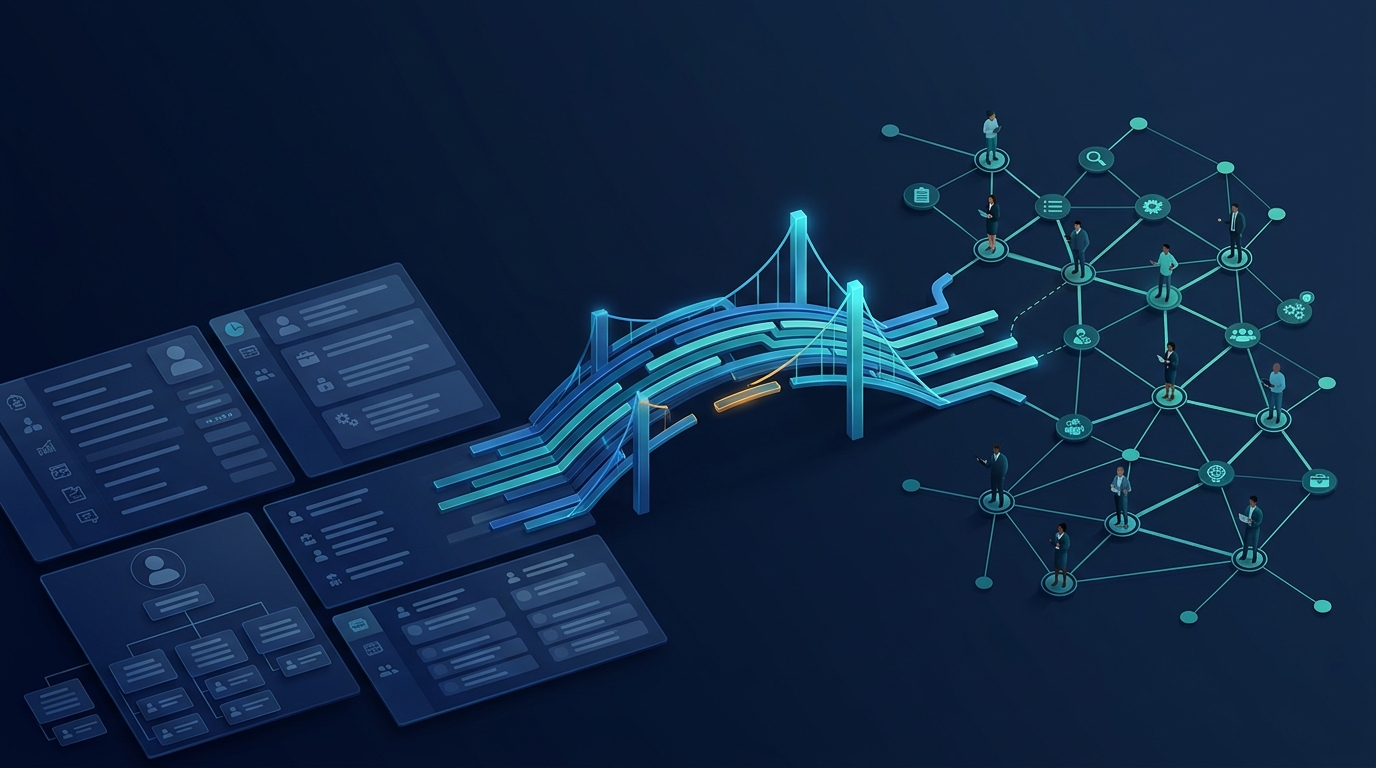
Most AI disappointments are not model failures. Instead, they come from fragmented information, unclear ownership, weak processes, and poorly integrated systems. An agent asked to “prepare onboarding” cannot succeed if the hire date lives in one system, the cost centre in another, and nobody knows who approves equipment.
Google Cloud’s AI agent trends 2026 report frames the shift as a move from one-off prompts and individual tasks toward systems that run entire workflows. Similarly, Google’s summary of five ways AI agents will change work in 2026 describes multiple agents coordinating to automate multi-step processes end to end.
Multi-step work, though, only holds together when four things are defined in advance:
- Data: which source is authoritative for each field.
- Tools: which systems and APIs the agent may call.
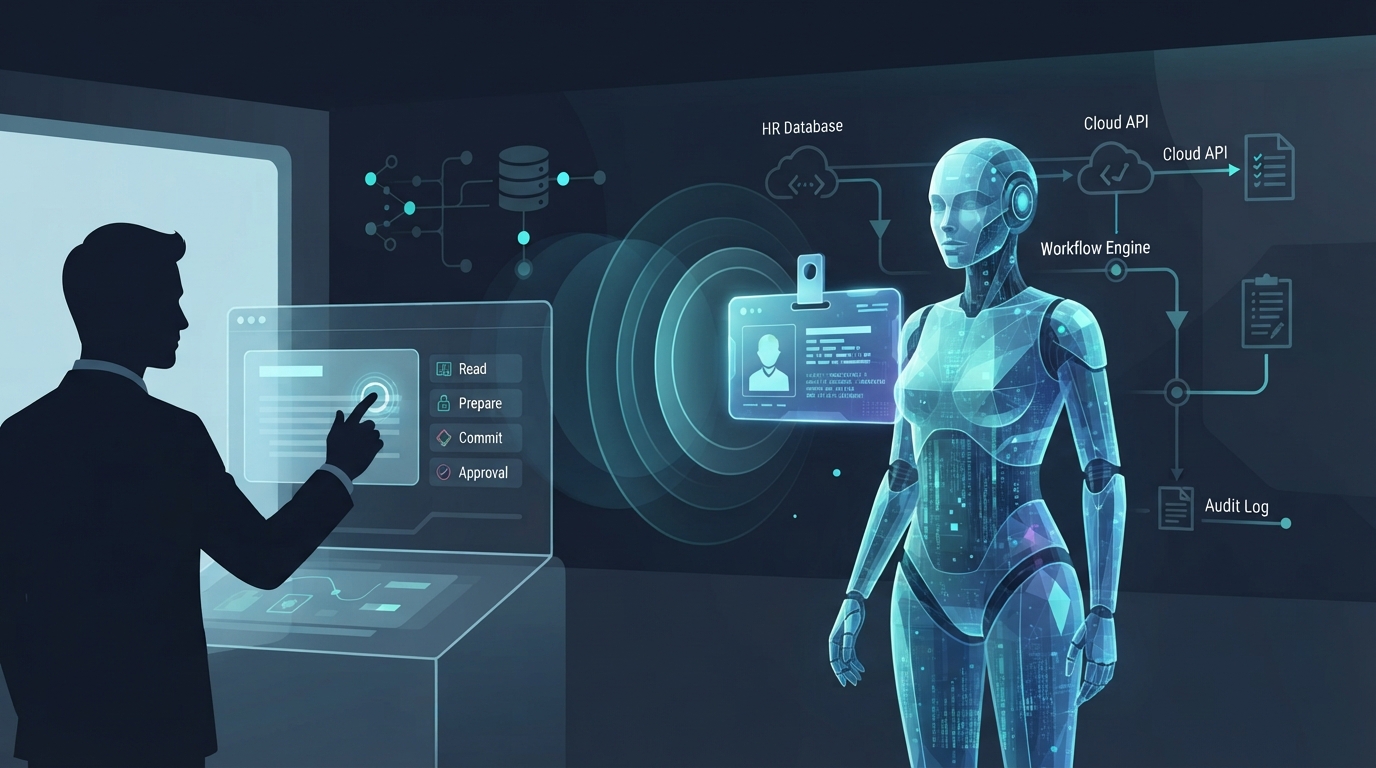
- Permissions: what the agent may read, write, or trigger.
- Escalation paths: when and to whom the agent must hand back.
For HR teams, disconnected platforms are often the first barrier. Our analysis of why fragmented HR systems derail AI projects explores this problem in more depth.
What Humans Must Continue to Own
As agents take on more steps, the human role becomes more defined, not less important. The World Economic Forum’s piece on defining roles for humans and AI places human value in defining problems, setting constraints, evaluating outcomes, and making final decisions. In practice, that translates into six responsibilities.
Framing the problem
People decide what problem is worth solving, what a good outcome looks like, and which parts of the work suit AI at all.
Setting goals and constraints
Humans define scope, risk limits, policy boundaries, and the data an agent may use.
Validating high-impact outcomes
Anything affecting pay, employment status, access rights, or customer commitments needs informed human review before it takes effect.
Managing exceptions
Agents handle the routine path. People handle the unusual case, the conflicting record, and the situation the rules did not anticipate.
Making ethical and people-related judgements
Context, fairness, and empathy in employee matters remain human work, particularly where an outcome affects someone’s livelihood or wellbeing.
Taking accountability
An AI system cannot hold legal, managerial, or employee-relations accountability. A named person or role must own each decision an agent supports, and that ownership should be documented.
Skills for the Human-Agent Workforce
Redesigned work demands redesigned skills. The World Economic Forum’s Future of Jobs Report 2025 found that employers expect 39% of workers’ core skills to change by 2030. AI and big data, networks and cybersecurity, and technological literacy are the fastest-growing skills, while around seven in ten employers consider analytical thinking essential. The same report identifies skill gaps as the leading barrier to business transformation.
For a human-agent workforce, that research points to a practical skill set:
- AI literacy: knowing what agents can and cannot do, and how to brief, check, and correct them.
- Analytical thinking: testing outputs against evidence rather than accepting them at face value.
- Systems thinking: understanding how a change in one step affects data, controls, and people downstream.
- Judgement: knowing when to accept, modify, reject, or escalate.
- Communication: writing clear instructions and explaining AI-supported decisions to employees.
- Resilience and continuous learning: adapting as tools and workflows keep changing.
Business professionals need enough technical fluency to supervise agents responsibly. Meanwhile, technology professionals need enough process and people context to design agents that fit real work. Google’s 2026 trends summary makes a similar point, arguing that ongoing, hands-on learning beats one-off training.
Enterprise Foundations: Data, Integration, Identity and Governance
Responsible human AI collaboration rests on architecture. Without these foundations, agentic workflows become hard to trust, audit, or scale.
Trusted data and integration
Agents should read from authoritative systems of record through governed APIs rather than spreadsheets or ad hoc extracts. In an SAP landscape, for example, that might mean SAP SuccessFactors as the source for employee master data, SAP S/4HANA for finance and organisational objects, and SAP Integration Suite (Cloud Integration/CPI) as the governed layer between them. Our guide to designing an AI-ready HR integration architecture walks through this pattern.
Identity, access and least privilege
Treat every agent as a distinct, non-human identity. Give it role-based access, the minimum permissions its task requires, and authentication through your enterprise identity provider using standards such as SSO and OAuth. Avoid shared service accounts with broad rights, because they make actions impossible to attribute.
Data minimisation
Expose only the fields an agent needs. An onboarding agent rarely needs salary history or medical leave records.
Human approval checkpoints and audit logs
Build approval steps into the workflow for consequential actions, and log every agent request, data access, and action so reviewers can reconstruct what happened.
Monitoring and incident response
Monitor agent behaviour for anomalies and include agents in incident-response plans, including a fast way to suspend an agent’s access. If your team is evaluating HR agents specifically, our checklist of what SAP SuccessFactors teams should verify before adopting AI agents is a useful companion.
A Practical Five-Step Operating Model
- Select a high-volume, low-risk workflow. Look for repetitive work with clear rules and limited harm if something goes wrong, such as onboarding preparation or routine case triage.
- Define the human owner, decision rights, and escalation path. Name who owns the outcome, what the agent may decide alone, and when it must hand back.
- Confirm data quality, system integration, and permissions. Fix the source data and integration gaps first, then grant narrowly scoped access.
- Pilot with clear boundaries and approval controls. Run the agent in a limited scope with human approval on consequential steps.
- Measure what matters. Track output quality, time saved, employee experience, adoption, exception volumes, and risk signals, not just speed.
Avoid the autonomy trap
Do not start by granting an AI agent unrestricted access to business systems or sensitive employee information. Begin with narrow permissions, transparent logs, defined escalation rules, and human approval for consequential actions.
For a deeper look at moving from experiments into live operations, see our article on taking agentic HR from pilot to production.
What Leaders Should Do Next
The Microsoft research shows why this deserves leadership attention now: 82% of leaders said they expect to use digital labour to expand workforce capacity within 12–18 months. Notably, far more leaders said they were considering hiring for new AI roles (78%) than reducing headcount (33%). Planning for a human-agent workforce is therefore as much about capability and roles as it is about cost.
- HR leaders: map which tasks in key roles could be agent-supported, update job architectures, and fund AI literacy programmes.
- CIOs and IT leaders: prioritise integration and data-quality fixes in the workflows you plan to automate.
- Enterprise architects: define reference patterns for agent access to systems of record, APIs, and event flows.
- Security and identity leaders: establish agent identity, least-privilege, logging, and kill-switch standards before scale.
- Business and operations leaders: nominate accountable owners and define what “good” looks like for each pilot.
Outlook: the next 12–24 months (editorial view)
The following is ITPro.Works’ editorial perspective, not a verified forecast. We expect enterprise AI adoption to shift from scattered assistants toward a smaller number of governed, end-to-end agentic workflows. Agent identity and access governance will likely become a standard part of IAM programmes, and roles such as agent owner or workflow steward may appear in job architectures. Organisations that skip the redesign work are likely to see pilots that impress in demos but struggle in production.
Where should people stay in control?
Which workflow in your organisation could benefit from AI support while still requiring clear human accountability? Share your view in the comments, and share this article with your HR, IT, security, and transformation teams.
Want more practical analysis like this? Subscribe to the ITPro.Works newsletter.
Conclusion: Redesign the Work, Not Just the Toolset
AI agents will not transform an organisation simply by being switched on. The real gains come from redesigning work around a responsible partnership between people and technology, with clear goals, trusted data, narrow permissions, and named human accountability. Leaders who build the human-agent workforce this way can capture the value of AI while keeping people firmly in charge of the decisions that matter.